

.webp)


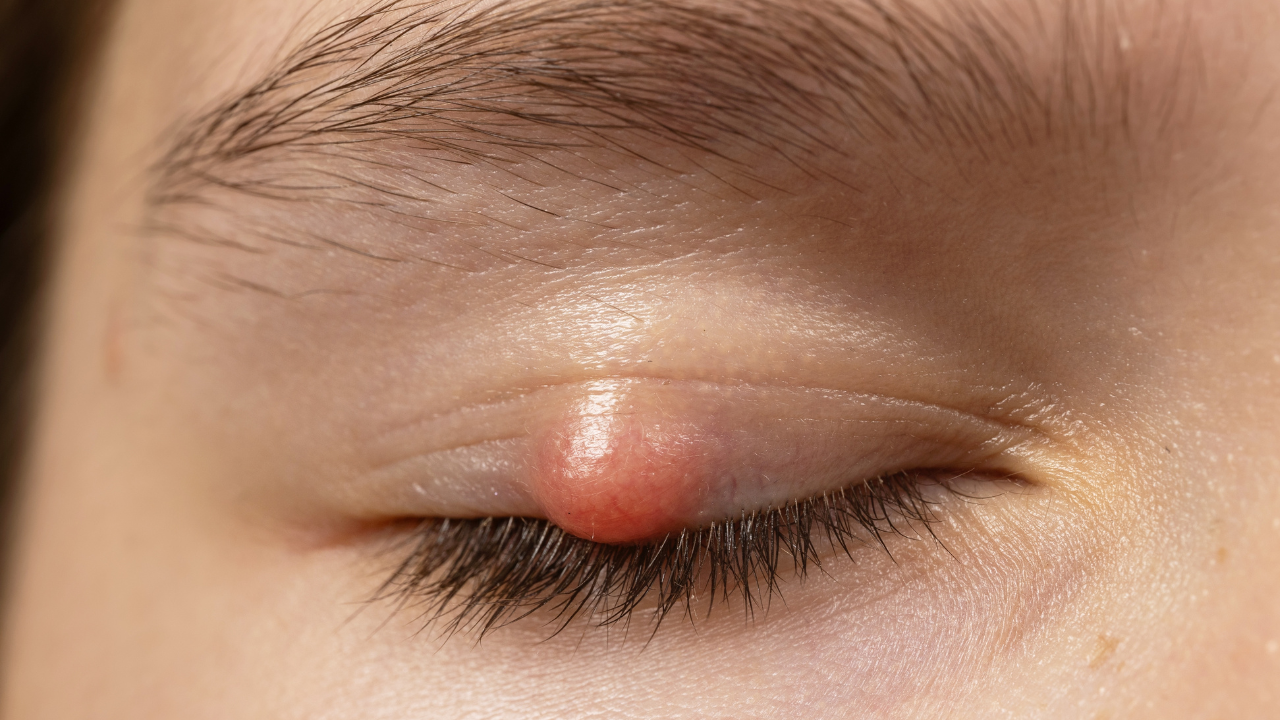
What is chalazion and hordeolum?
A hordeolum is an acute inflammation of one of the many small sebaceous glands that are located in the edge of or in the eyelid itself. These glands normally produce an oily substance that helps keep your eye supple and protected. When such a gland becomes infected by bacteria, painful swelling occurs. The most common culprit is Staphylococcus aureus, a bacteria that normally lives on your skin without causing problems. Under certain circumstances, however, this bacteria can enter a gland and cause an infection there.
The word hordeolum may sound unfamiliar, but you probably know it by one of the many folk names. In Flanders and the Netherlands, it is often called a stye, but terms that are also used are toadzeiker, horseshoe, wine, quill or pisoog. According to popular belief, you would get it if you did your business on the path next to the church, but of course not a word of that is true. It's just bacteria that are the cause
A chalazion occurs in a different way, although the starting point is the same: a sebaceous gland in your eyelid. In a chalazion, the gland's drainage channel becomes clogged. The sebum that normally comes out through this channel therefore remains trapped in the gland. When too much sebum builds up, the gland can burst and its contents end up in the surrounding tissue. Your body responds to this by sending inflammatory cells, which leads to the formation of a firm, hard lump: a fat granuloma. This is what we call a chalazion or barley grain.
Interestingly, a chalazion and a hordeolum can merge. A chalazion can become infected and then turn into a hordeolum filled with pus. Conversely, a hordeolum can be left behind as a chalazion after deflating. These are therefore closely related disorders that at first glance look alike but have a different origin.
We don't have precise figures for Belgium, but in the Netherlands, around five out of a thousand people per year experience a chalazion or hordeolum. They are more common in children and young adults, although people of any age can develop them. Both disorders have the annoying feature of recurring frequently, sometimes in the same place but also in a different eyelid.
Heb je last van Chalazion and Hordeolum (stye)?
Laat je huid beoordelen door een erkende dermatoloog via de Skindr app. Upload foto's en krijg binnen 48 uur een diagnose met persoonlijk advies. Geen wachtkamer, geen verwijsbrief nodig.
How does a chalazion or hordeolum occur?
The development of a hordeolum begins with the entry of bacteria into a sebaceous gland. Your eyelid edges contain dozens of tiny glands that all have an opening to the outside. Normally, your natural defenses and the continuous removal of sebum keep bacteria out. But sometimes that doesn't work.
The Staphylococcus aureus bacteria is an opportunist that is constantly present on your skin, waiting for an opportunity. When a gland opening becomes temporarily blocked, for example due to dander or dust after work, or when the gland is irritated, the bacteria can slip in. Once inside, she finds an ideal environment: warm, humid and full of nutrients. The bacteria multiplies rapidly and your immune system responds by sending inflammatory cells. The result is a swollen, red, sore spot full of pus: a hordeolum.
A chalazion is created in a more mechanical way. The sebaceous glands in your eyelids are constantly producing an oily substance. It has to go out through small channels, where it mixes with your tear fluid and helps keep your eye supple. When such a drainage channel becomes clogged, the sebum continues to accumulate behind the blockage. The gland swells like a mini balloon. At some point, the pressure becomes too great and the gland bursts, causing sebum to leak into the surrounding tissue. Your body recognizes this sebum as foreign material and sends inflammatory cells to clean up. This reaction leads to the formation of a solid nodule of inflammatory tissue and encapsulated sebum.
Certain factors increase the chance that you will develop a chalazion or hordeolum. Dry eyes are a major risk factor. When your eyes don't produce enough tear fluid or when the quality of your tears is reduced, your eyelid edges can become irritated and the gland openings clogged. Long-term eyelid margin inflammation, called blepharitis in medical terms, is another known risk factor. In this condition, your eyelid edges are chronically inflamed and irritated, leading to blocked glands and increased susceptibility to infections. Working in a dusty environment can also lead to the blockage and inflammation of these glands. If necessary, wear protective glasses and clean your face and eyes afterwards with lukewarm water.
Seborrheic eczema, a skin condition where your skin is oily and flakes quickly, also increases the risk. This condition often affects the face, including the eyelids, and can lead to clogged sebaceous glands. People who wear a lot of makeup around their eyes, especially if they don't remove it thoroughly at night, are also more at risk. This is because leftovers of eye makeup can block the small gland openings.
Symptoms and characteristics of a chalazion and hordeolum
A hordeolum usually announces itself suddenly. You feel a sore spot on your eyelid that swells quickly. The area turns red and tense. When you blink, you feel pain, and it looks like something is in your eye. When you look in the mirror, you can see a clear swelling. The location determines whether we speak of an external or internal hordeolum.
An external hordeolum sits at the edge of your eyelid, right where your lashes are. You'll see a red, swollen spot that looks like a small pimple. After a few days, a yellow dot often appears: the pus that has collected and shines through the skin. This yellow cup can break open spontaneously, after which the pus comes out and the pressure and pain decrease. After deflating, the swelling usually disappears within a few days.
An internal hordeolum sits deeper in your eyelid, away from the edge. This occurs in one of the larger sebaceous glands that are located in the eyelid itself. From the outside, you can only see a swelling of the eyelid, with no obvious yellow head. This form is often more painful because the inflammation puts more pressure on the surrounding tissue. An internal hordeolum can evolve into a chalazion when the acute inflammation is over but a hard lump remains.
A chalazion feels very different than a hordeolum. It is a hard, firm lump that grows slowly over days to weeks. Unlike a hordeolum, a chalazion is usually not painful unless it becomes infected. You just feel a lump in your eyelid that won't go away. The lump is often in the middle of your eyelid or at the base, not at the edge where your lashes are. The upper eyelid is affected more frequently than the lower one.
When you invert your eyelid, you can sometimes see a reddish or yellowish discoloration on the inside of the chalazion. The lump is easy to feel like a hard pea under your skin. Some people develop multiple chalazions at the same time, sometimes in both eyes. That is annoying but not dangerous.
A hordeolum or chalazion may increase tear fluid: your eye seems to be tearing for no apparent reason. This is due to eyelid irritation and is temporary.
Where does a chalazion or Hordeolum occur?
The location of these eyelid disorders follows a distinct pattern associated with the anatomy of your eyelids.
A hordeolum can occur in both your upper and lower eyelids, although the upper eyelid is slightly more commonly affected. The outer shape is right at the edge of your eyelid, near the base of your lashes. This is logical, because this is where the Zeis and Moll glands are located, small sebaceous glands that feed the eyelashes. When one of these glands becomes infected, an external hordeolum is created at that specific location.
An internal hordeolum originates deeper in the eyelid, in the so-called Meibomian glands. These larger glands lie in a row behind your lashes, embedded in the cartilaginous part of your eyelid. There are about twenty to thirty of them in each eyelid. Because they lie deeper, their inflammation causes swelling that comes more from the eyelid itself than from the edge.
A chalazion is almost always located in the upper eyelid, although it can also occur in the lower one. The preferred spot is the middle of the eyelid, halfway between the lash line and the eyelid crease. You can feel the lump best when you gently hold your eyelid between your thumb and forefinger. The chalazion shifts slightly when you rub your finger over your closed eyelid, because it is not attached to the skin but lies in the tissue underneath.
Sometimes multiple chalazions form in the same eyelid, like beads on a cord. This occurs in people who are susceptible to this condition, for example due to chronic eyelid margin inflammation. Chalazions can also occur in both eyes at the same time, which is particularly seen in underlying conditions such as seborrheic eczema.
The sizes of both hordeolums and chalazions can vary greatly. A small hordeolum is barely visible and feels like a tiny bump. A large one can make the entire eyelid swell, causing your eye to be almost closed. Chalazions range from pea to sometimes even marble size, although the latter is rare.
Heb je last van Chalazion and Hordeolum (stye)?
Laat je huid beoordelen door een erkende dermatoloog via de Skindr app. Upload foto's en krijg binnen 48 uur een diagnose met persoonlijk advies. Geen wachtkamer, geen verwijsbrief nodig.
Treatment of a chalazion and hordeolum
Treating eyelid disorders requires patience, as both hordeolums and chalazions tend to heal slowly. Fortunately, no major treatment is often necessary.
In a hordeolum, waiting is often the best strategy. Most hordeolums heal spontaneously within one to two weeks. The suppuration breaks open on its own, the pus runs away and the swelling disappears. During this period, you can take measures yourself to support the healing process and reduce discomfort.
Heat is your best friend for eyelid problems. A wet, lukewarm washcloth on your closed eyelid brings relief and helps the inflammation mature. Dry heat is even more effective, for example via a warm cherry stone pillow or special eye mask that you can heat up in the microwave. Hold the heat against your eyelid for ten to fifteen minutes four times a day. This improves blood flow, helps pus come out and relieves pain.
Do you have oily eyelids or frequent eyelid inflammation? Then you can preventively clean your eyelid edges with (unscented hypo-allergenic) baby shampoo. Dilute a little bit of baby shampoo with lukewarm water, apply it to a cotton swab or clean finger, and massage gently around your closed eyelid edges. Then rinse thoroughly. This degreasing helps open blocked gland openings and reduces the risk of new hordeolums. Do this once or twice a day, including between episodes.
If the hordeolum is very sore and has a distinct pus that does not open spontaneously, your doctor may decide to prick it carefully with a sterile needle. This provides immediate relief because the pus can drain away and the pressure disappears. This is a small procedure that can be done in practice.
If there is no improvement, your doctor may prescribe antibiotic eye drops. These help fight the bacterial infection and can accelerate the healing process. You usually have to apply the drops several times a day for about a week.
An even more wait-and-see policy applies to a chalazion. Chalazions often disappear spontaneously, even when they initially appear to be growing. However, this can take months. During that time, you can apply the same heat treatments as with a hordeolum. The heat helps open the clogged gland and allow the trapped sebum to drain away. Gently massaging the eyelid in the direction of the lashes can also help.
Does a chalazion persist after three months, or does it become so big that it affects your vision or is cosmetically disturbing? Then surgical removal may be considered. This is a minor procedure that usually takes place under local anaesthesia. The ophthalmologist makes a small incision on the inside of your eyelid and scoops out the chalazion. The wound usually does not need to be stitched and heals on its own. After the procedure, you will receive antibiotic eye ointment to prevent infection.
Another treatment option is to inject an anti-inflammatory agent into the chalazion. Here, the doctor injects a small amount of corticosteroids directly into the nodule. This can cause the chalazion to shrink, although it is not always effective. This treatment is only performed by experienced doctors because it involves risks such as skin discoloration or tissue damage if administered incorrectly.
It's important not to fiddle with your eyelid yourself or try to squeeze out the hordeolum like you would with a pimple. This can spread and worsen the infection. You should also leave contact lenses off until the inflammation is completely healed. Lenses irritate your eye extra and can spread infection.
For people with underlying conditions such as eyelid inflammation, dry eyes or seborrheic eczema, it is also essential to treat these basic problems. Without it, chalazions and hordeolums keep recurring frequently. Your doctor can suggest various treatments for this, from artificial tears to medical eye drops.
A chalazion that occurs after the age of fifty, that looks atypical, or that stays in the same place for a long time requires extra attention. In these cases, your doctor will refer you to an ophthalmologist. They may take a biopsy to rule out a malignant tumor posing as a chalazion. Fortunately, this is very rare, but it is important to rule it out.
What doesn't work against a chalazion and hordeolum
As with many conditions, there are several misconceptions about treating eyelid problems. It's helpful to know what isn't helping so you can focus your efforts on proven effective methods.
Squeezing out a hordeolum is a bad idea, even if the temptation is great. This seems logical because you do the same thing with pimples on your face, but it's different with your eyelids. Pinching can push the infection deeper into your eyelid or even spread it to surrounding structures. In addition, scars can occur on your sensitive eyelid skin. Let a hordeolum break open spontaneously or have your doctor prick it in if necessary.
Several over-the-counter eye ointments and drops are touted for eyelid problems, but many of them have no proven effect. Some contain plant extracts or homeopathic ingredients whose effectiveness has not been demonstrated. Ask your doctor or pharmacist for advice before making a purchase.
The idea that you can make a chalazion disappear by pressing it hard or massaging it vigorously is false and even harmful. Gently massaging in the direction of the lashes can help guide the blocked sebum out, but pressing hard only causes pain and can damage the tissue.
Antibiotics in tablet form have no added value to a simple hordeolum. Local treatment with drops is more effective because the drug gets directly to where it is needed. Tablets are only considered for extensive or complicated infections, which is rare.
Various home remedies are circulating, from placing a gold ring on the hordeolum to using urine or saliva. All of these have no proven effect and may even involve risks of infection. Stick to simple, proven effective methods: warmth, hygiene and patience.
Wearing an artificial heat lens permanently to prevent chalazions is neither necessary nor effective. The periodic heat applications described above are sufficient. In addition, constant heat can cause other problems such as skin irritation.
Finally, vitamin A supplements, although sometimes recommended, have not been proven to help against chalazions or hordeolums. Unless you have a real vitamin A deficiency, which is rare in Western countries, extra intake will not change your eyelid problems.
Frequently asked questions about chalazion and hordeolum
What is the difference between a chalazion and a hordeolum?
A hordeolum is an acute bacterial infection of a sebaceous gland in your eyelid, often painful with redness and pus. A chalazion is a chronic, usually painless swelling caused by a blocked sebaceous gland drain. It feels like a hard lump. In practice, they can merge: a hordeolum can remain as a chalazion after healing, and a chalazion can become infected and turn into a hordeolum. The distinction is sometimes difficult to make, even for doctors, but it often doesn't matter much for treatment.
Can you prevent a hordeolum or chalazion?
Partly yes. Good eyelid hygiene is the basis. If you often suffer from eyelid problems, cleanse your eyelid edges daily with diluted baby shampoo. In the evening, remove your eye makeup thoroughly. Don't rub your eyes with your hands too much, especially dirty hands. Treat underlying problems such as dry eyes or eyelid inflammation adequately. For dry eyes, use artificial tears. If you wear contact lenses, ensure strict lens hygiene and do not wear them longer than recommended. In the case of a hordeolum, you are temporarily not allowed to wear contact lenses. However, you cannot prevent all cases; some people remain susceptible despite all measures.
Are chalazion and hordeolum contagious?
In principle, a hordeolum can be contagious because it is a bacterial infection. The bacteria can be transmitted through direct contact or shared towels and washcloths. That is why it is wise to use your own towel during an active infection, wash your hands regularly and avoid touching your eye. A chalazion, on the other hand, is not contagious because it is not an infection but a mechanical blockage with an inflammatory response. Nevertheless, good hygiene is always important to prevent complications.
How long does it take for a chalazion or hordeolum to disappear?
A hordeolum usually heals spontaneously or with minimal treatment within one to two weeks. It can take up to three weeks for all the swelling to completely disappear. A chalazion lasts longer: from a few weeks to even three to four months. Some never disappear completely spontaneously and eventually require surgical removal. Heat treatments can accelerate the healing process in either case. If you still have obvious swelling after four weeks, contact your doctor.
When to see a doctor
For a simple hordeolum, you don't always have to go to the doctor. If the pain is bearable and you see it developing as expected, you can try heat treatments yourself first. Do see your doctor if the pain is very severe, if the swelling affects the entire eyelid, if you get a fever, or if there is no improvement after two weeks. You can often wait a few weeks before heat treatments for a chalazion, but contact us if it affects your vision, if it becomes painful, or if it doesn't disappear after three months. For people over fifty, it is wise to have a non-disappearing or atypical chalazion checked by an ophthalmologist.
Can chalazion and hordeolum come back?
Yes, unfortunately, both disorders recur frequently. Some people are simply more susceptible than others, for example because of the structure of their eyelid edges, the composition of their sebum production, or underlying disorders. A chalazion or hordeolum can recur in the same spot, but also in a different eyelid. In case of frequently recurring problems, it is wise to take preventive measures such as daily eyelid hygiene and treatment of underlying conditions. Your doctor can refer you to an ophthalmologist if the problems continue to recur frequently despite all measures.
Can a chalazion be dangerous?
In general, a chalazion is a harmless condition that is at most cosmetically disturbing or temporarily affects your vision due to pressure on your eyeball. Very rarely, however, what looks like a chalazion can be a malignant tumor, especially in the elderly. That's why medical assessment is important for atypical presentations or chalazions that occur after age 50. A large chalazion that puts pressure on your eyeball for a long time can in theory permanently deform your cornea, but this is very rare and can be prevented by timely removal.


.svg)
