

.webp)


What is rosacea?
Rosacea is a chronic inflammatory skin disorder that mainly affects the face. The name comes from the Latin word for rose, which refers to the characteristic red color of the affected skin. The condition typically develops in the central part of your face. The nose, cheeks, forehead, and chin are the most affected. Unlike acne, rosacea usually starts in middle age and doesn't go away on its own.
The course varies with floods where symptoms increase, followed by periods of relative calm. These outbursts can be triggered by various factors that vary from person to person. Rosacea mainly occurs in light-skinned people. People with Celtic or Northern European ancestry have the highest risk. Women are more likely to be affected than men, although men often develop more severe forms.
The exact cause remains unclear, despite much research. There appears to be an inherited component. Several mechanisms are likely to play a role, including blood vessel abnormalities and a hypersensitive immune system.
Heb je last van Rosacea?
Laat je huid beoordelen door een erkende dermatoloog via de Skindr app. Upload foto's en krijg binnen 48 uur een diagnose met persoonlijk advies. Geen wachtkamer, geen verwijsbrief nodig.
How does rosacea occur?
The development of rosacea is a complex process in which various factors play a role. Hereditary predisposition seems to be important. If one or both parents have rosacea, you're more likely to develop it too. Research has shown that certain gene variants are more common in people with rosacea, especially genes involved in the immune system and blood vessel regulation.
Abnormalities in the blood vessels play a central role. In people with rosacea, the blood vessels overreact to stimuli. These blood vessels dilate easily and stay dilated longer, leading to redness. Over time, the dilated blood vessels can remain permanently visible. The immune system in the skin reacts differently than in people without the condition. There is an increased presence of inflammatory cells and inflammatory agents. This explains why rosacea is an inflammatory condition and not just a blood vessel problem.
An interesting discovery is the possible role of demodex mites, microscopic skin mites that live on everyone's skin. In people with rosacea, these mites appear to occur in greater numbers. The immune system could overreact to these mites or bacteria that live in them.
Various trigger factors can trigger outbursts. Heat is a common trigger, whether it's from hot drinks, spicy food, a hot shower, or intense exercise. Sunlight and wind can also trigger rosacea. Alcohol, especially red wine, is a familiar trigger for many people. Rosacea, however, is definitely not a sign of excessive alcohol consumption. Stress and strong emotions can trigger flare-ups by causing blood vessel dilation. Certain cosmetics and skin care products can also cause irritation to sensitive skin. Creams containing cortisone can even cause or worsen rosacea when used on the face for long periods of time.
Symptoms and characteristics of rosacea
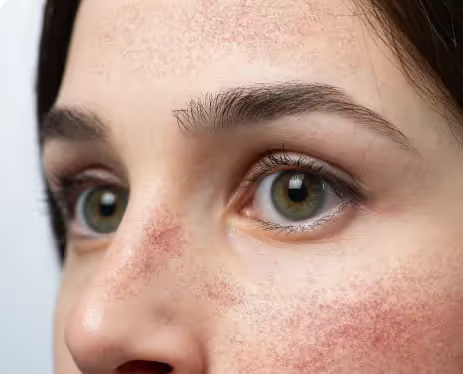
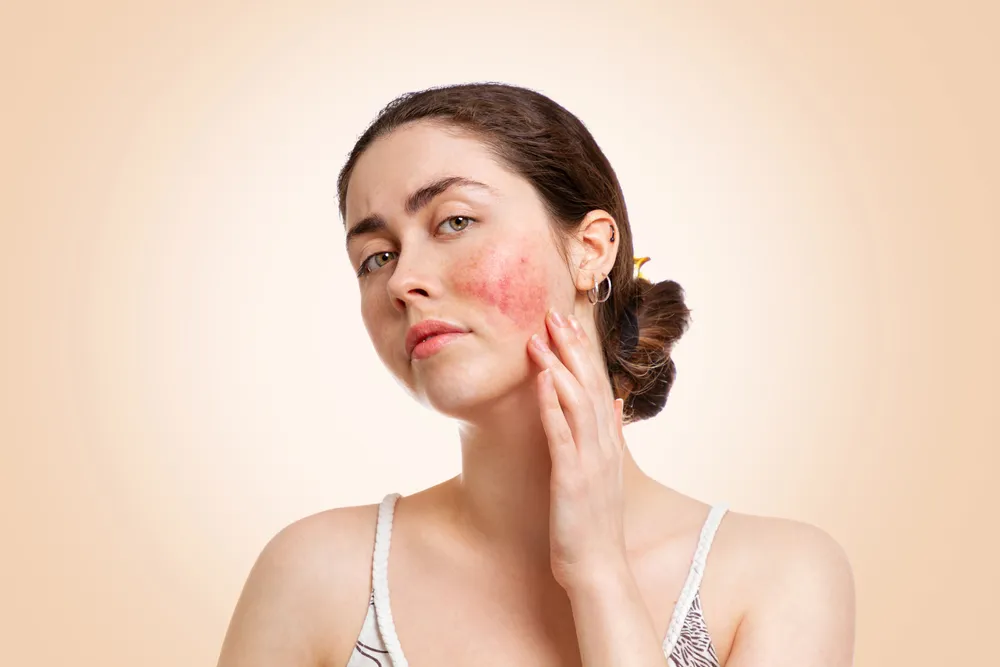
Rosacea has four main characteristics that can occur in different combinations. Not everyone has all the characteristics, and the severity varies widely. The most prominent feature is redness of the skin on the face. In the beginning, this appears as short-term blushing where your face suddenly turns red. Gradually, the redness becomes more persistent and the skin remains permanently red, especially on the cheeks and nose.
The second characteristic is the development of visible blood vessels, medically called couperose. These are fine red lines or a spiderweb-like pattern, particularly visible on the cheeks and around the nose. Papules and pustules are the third characteristic. Papules are small red bumps, while pustules are bumps with a white or yellow tip. An important difference with acne is the absence of comedones, black or white blackheads. The pimples in rosacea are caused purely by inflammation.
The fourth characteristic, mainly in older men, is skin thickening. This can lead to a swollen, lumpy texture, especially on the nose. In severe cases, rhinophyma develops where the nose is greatly enlarged and irregularly shaped. Fortunately, this is rare.
Around half of the people also suffer from eye problems, called ocular rosacea. The eyes feel dry, burn, or sting. There may be a feeling that there is sand in your eyes. The eyes may be red, tearful, and sensitive to light. These eye complaints can even occur before skin symptoms manifest. The affected skin often feels sensitive and is easily irritated. Many people experience a feeling of tightness, burning or stinging, especially during flare-ups.
Where does rosacea occur?
Rosacea has a very distinctive distribution across the face. The disorder is almost always limited to the central part and follows a predictable pattern. The nose is often the first and most prominent affected. Many people notice that their noses turn red regularly and that small visible blood vessels appear. The cheeks are also a preferred location, with both cheeks usually affected symmetrically. The forehead, especially the central part, may also be affected. The chin is regularly included in the affected area. It is striking that rosacea almost never spreads to the hairline, the area around the ears, or the neck.
An important feature is that certain areas are typically spared. The skin around the eyes usually remains free of lesions, although the eyelids themselves can become inflamed. The skin around the mouth is also often spared, which sometimes leads to a contrasting pattern. It is very unusual for rosacea to manifest outside the face. In exceptional cases, the condition can also affect the neck or chest, but this is rare.
Heb je last van Rosacea?
Laat je huid beoordelen door een erkende dermatoloog via de Skindr app. Upload foto's en krijg binnen 48 uur een diagnose met persoonlijk advies. Geen wachtkamer, geen verwijsbrief nodig.
Treatment of rosacea
The treatment of rosacea is aimed at controlling the symptoms and preventing progression. Because rosacea has no cure, treatment usually combines self-care measures and medical treatments.
Local treatment with creams or gels forms the basis. These agents have an anti-inflammatory effect and help reduce papules and pustules. You apply the product to affected areas once or twice a day. It usually takes one to three months before you see a clear improvement. Maintenance treatment is important because rosacea comes back. After improvement, it is wise to continue using the local treatment, for example two to three times a week. Without maintenance treatment, most people's symptoms will return within a few months.
For people for whom local treatment does not work enough, oral medications may be considered. Low doses of certain antibiotics, used for their anti-inflammatory properties, may be effective. This treatment usually takes six to twelve weeks and is always combined with topical treatment. For permanent redness and visible blood vessels, creams and tablets are less effective. Laser treatment or IPL treatments can reduce these blood vessels. Multiple treatments are usually necessary and the results are not always permanent.
In the rare cases of severe rhinophyma, surgical options may be considered. Laser treatment, freezing, or plastic surgery can remove excess tissue. In the case of ocular rosacea, it is important to take good care of the eyes. Cleaning the eyelids regularly with special cleansers can help. In case of serious eye problems, a referral to an ophthalmologist is necessary.
In addition to medical treatments, self-care is crucial. Identifying and avoiding personal triggers can significantly reduce the number of outbreaks. Sun protection is essential because sunlight is a common trigger. Use sunscreen with a high protection factor daily, even on cloudy days. Skin care should be gentle and minimalistic. Use gentle, fragrance-free cleaning products and avoid scrubbing or aggressive rubbing. Always test new products on a small area before applying them all over the face.
What doesn't work for rosacea?
There are several misconceptions about treating rosacea, and certain approaches can make the situation worse. Creams containing cortisone are sometimes used incorrectly, but this is a serious mistake. Although cortisone may initially improve, long-term use on the face actually leads to the development or worsening of rosacea. When you stop taking the cortisone cream, a serious rebound reaction can occur where the skin temporarily becomes much worse.
Aggressive skin care with harsh scrubs, peels or strong anti-acne products worsens rosacea. The skin in rosacea is sensitive and irritated, not dirty or clogged. Products containing alcohol, perfume, or other irritating ingredients should be avoided. Antibiotic creams used for acne have little or no effect on rosacea. Although oral antibiotics may help because of their anti-inflammatory effects, topical antibiotics for acne do not do this.
Natural remedies and supplements are often promoted, but scientific evidence of their effectiveness is lacking. Some essential oils can even irritate sensitive skin extra. Completely ignoring rosacea in the hope that it will go away on its own is not a good strategy. Untreated rosacea tends to worsen gradually. Early treatment can prevent progression to more severe stages.
Frequently asked questions about rosacea
Is rosacea contagious?
No, rosacea is definitely not contagious. You can't transfer it to others by touching, sharing towels, or in any way. It is a chronic inflammatory condition in which your own skin reacts hypersensitively to various stimuli.
Can rosacea heal completely?
Unfortunately, rosacea is not curable, but it is treatable. With the right treatment and by avoiding triggers, the symptoms can be greatly reduced and kept under control for a long time. Many people have little or no problems with maintenance treatment for months.
Is rosacea caused by drinking too much alcohol?
No, this is a persistent misunderstanding. Alcohol can trigger outbreaks in many people, but rosacea is not caused by alcohol consumption. Many people with rosacea don't drink alcohol at all. This misconception can be extremely burdensome.
Should I avoid certain foods?
This is very personal and varies from individual to individual. Common triggers include hot drinks, spicy food, and alcohol. It's a good idea to keep a journal where you write down what you eat and when you get upset. This is how you can identify your personal triggers.
Can I just use makeup with rosacea?
Yes, makeup can even be very useful to disguise redness. However, choose products that are specifically suitable for sensitive skin and are free of irritating ingredients. Green correction products can neutralize redness. Always test new products first.
Will rosacea get worse as I get older?
Not necessarily. Untreated rosacea does tend to worsen gradually, but with good treatment, progression can be prevented. Some people experience that their rosacea actually becomes stable or even decreases after years. Each course is individual.
Bronnen
Skindr Dermatologists
Gezondheidenwetenschap.be - Rosacea
Ebpnet.be - Evidence-based guidelines
Thuisarts.nl - Rosacea
Huidziekten.nl - Rosacea Patient Folder





.avif)


.svg)
