

.webp)


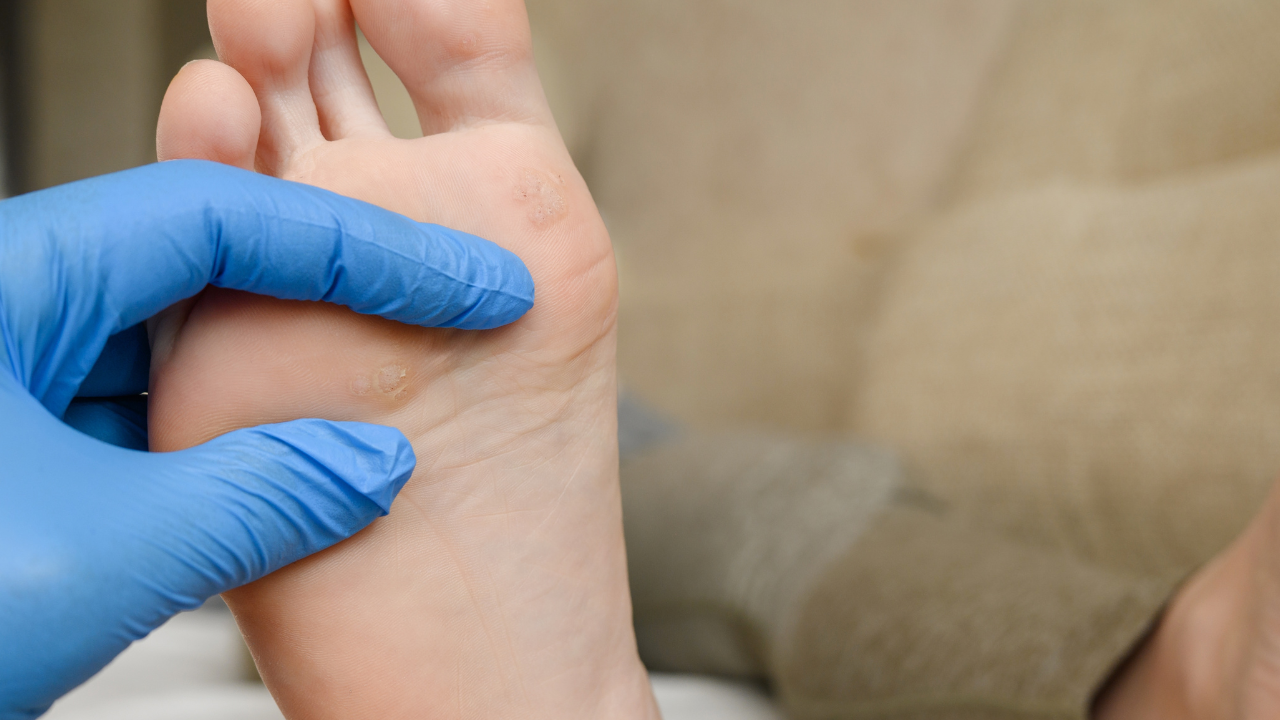
What are warts?
Warts are small, raised skin growths caused by an infection with the human papillomavirus, known as HPV for short. This virus belongs to a large family with over a hundred different types, some of which cause warts on the skin and others are involved in mucosal disorders. It is important to note that the HPV types that cause skin warts are different from those that cause genital warts or cervical cancer.
The virus enters the skin through small wounds or damage that you often don't even notice. Once in the skin, the virus causes the skin cells to divide and accumulate more quickly, resulting in the characteristic raised wart. The process is gradual and it can take weeks to months before a wart becomes visible after the initial infection.
Warts are not dangerous and always benign, but they can be annoying. They can hurt, especially when they sit on pressure points such as the soles of the feet. They can also be cosmetically annoying, especially when they are visible on the face or hands. The presence of warts can cause social discomfort, although there's really no reason to be ashamed of this very common condition.
The virus survives well in humid, warm environments such as swimming pools, showers and sports locker rooms. This explains why warts on the feet are so common and why they are easily spread in these environments. Wet towels and gym mats can also be used as a means of transmission.
Not everyone who comes into contact with the HPV virus develops warts. Your immune system plays an important role in the resistance to the virus. People with a reduced immune system, for example due to AIDS, chemotherapy or drugs that suppress the immune system, are more susceptible to warts and often have more and more persistent ones.
Heb je last van Warts?
Laat je huid beoordelen door een erkende dermatoloog via de Skindr app. Upload foto's en krijg binnen 48 uur een diagnose met persoonlijk advies. Geen wachtkamer, geen verwijsbrief nodig.
How do warts occur?
The development of warts begins with the transmission of the HPV virus from person to person or through contaminated surfaces. This happens especially easily if you have small wounds or damage to the skin yourself.
The virus can survive for a short time on towels, changing room floors, pool edges and sports mats. That is why it is often recommended to wear slippers in swimming pools and communal showers, although this cannot completely prevent the spread. Sharing towels, shoes, or socks with someone who has warts increases the risk of infection.
After infection, the virus penetrates the skin and infects the top layer of skin cells. The virus causes these cells to divide uncontrollably. This leads to a buildup of skin cells in one spot, resulting in the raised wart that you can see from the outside. This process is slow and it can take a few weeks to months before a wart becomes visible.
Once you have one wart, you can also re-infect yourself by touching the wart and then touching another part of your body. This is called auto-inoculation. Scratching or picking at warts, in particular, increases this risk, because it creates small wounds through which the virus can easily enter. This explains why warts often occur in groups.
Your immune system plays a crucial role in how warts develop. In most people, the body builds up antibodies against the virus over time. This is why most warts disappear spontaneously after a few years. In children and adolescents, the immune system is still developing, which explains why warts are so common in this age group. Adults usually have already built up antibodies and are therefore less likely to get warts.
Certain factors make you more susceptible to developing warts. Swimming regularly, especially if you don't dry your feet properly afterwards, increases the risk. People who come into frequent contact with meat in their profession, such as butchers, have an increased risk of warts on the hands. Damaged skin, for example due to eczema or regular nail biting, also offers the virus more entry points.
Symptoms and characteristics of warts
Warts can look very different depending on the type and location on the body. Recognizing the different types helps to take the right approach and to distinguish warts from other skin conditions that can sometimes look like them.
Classic warts, also known as common warts or verrucae vulgares, are the most common form. They are round or oval with a rough, uneven surface that is often compared to a cauliflower. The color ranges from skin-colored to light brown or grayish. These warts feel hard when touched and often have small black dots in the middle, which are actually small blood vessels. They mainly occur on the hands, fingers, elbows, knees and around the nails.
Plantar warts, called verrucae plantares, sit on the soles of the feet and behave differently than other warts. Due to the pressure of your body weight, they grow inward instead of outward. They are often covered with a thick layer of calluses, which can make them look like a corn. The distinction is important because the treatment differs. Warts interrupt the skin lines, while a corn follows the skin lines. If you remove the callus carefully, you will see small black dots in a wart, which is not the case with a corn.
Plantar warts can be painful, especially when they're right at a pressure point you're walking on. The pain gets worse when walking or standing and can sometimes be so annoying that you will limp. However, some people have no pain at all, especially when the wart is on the side of the foot where there is less pressure.
Flat warts, verrucae planae, are small, flat, and smooth compared to common warts. They are often barely raised and have a smoother surface. These warts often occur in large numbers and usually appear on the face, forehead, or hands. In children, they also regularly occur on the knees. They are skin colored to light brown and are mainly experienced as cosmetically annoying.
Filamentous warts, verrucae filiformes, are long, narrow projections that occur mainly in the face, around the mouth, nose, or eyelids. They look like a tiny ribbon of skin that sticks up. This shape is less common but can be annoying due to its location.
When you try to cut out or scratch a wart, small spot bleeding occurs. This is because there are tiny blood vessels in the wart. This is a characteristic sign that helps distinguish warts from calluses or skin discoloration.
Where do warts occur?
In principle, warts can occur anywhere on the skin where the HPV virus enters, but certain locations are much more common than others. The pattern depends on how the virus is transmitted and which parts of the skin are most exposed to infection.
The hands are a common location. This is because we constantly use our hands to touch things, so they often come into contact with the virus. Warts on the hands are mainly on the fingers, the back of the hand and around the nails. In children, you also often see them on the knuckles. People who bite their nails or pick at the cuticles are more likely to get warts in this area because they constantly make small wounds.
The feet are the second most common area, especially the soles. People often contract these plantar warts in swimming pools, communal showers and changing rooms where the virus survives well on wet floors. The warts are usually on the footballs, under the toes, or on the heels where the most pressure comes from walking. Sometimes they appear between the toes where it is often damp.
The knees and elbows are also areas where you see warts regularly, especially in children. This is because children often play on their knees and rest their elbows on tables or other surfaces. These areas also often have minor scrapes from falls or impacts, providing entry points for the virus.
The face is a less common but conspicuous location for warts. This is where flat warts or filamentous warts mainly appear. They can occur on the forehead, cheeks, around the nose, and on the chin. In men, they also occur in the beard, where they can be spread by shaving. Warts on the face are mainly experienced as cosmetically annoying.
Genital warts are a separate category and appear on and around the genitals. These are caused by types of HPV other than common skin warts and are sexually transmitted. They occur around the penis, vagina, anus and in the pubic area. These warts are pink-red to grey-white and usually stand in groups.
Warts can also appear in unusual places such as on the lips, in the mouth, or even on the eyelids. These locations are rarer but can be extra annoying. Warts often spread over the body when you scratch an existing wart and then touch another part of the body, especially if there are also small wounds there.
Heb je last van Warts?
Laat je huid beoordelen door een erkende dermatoloog via de Skindr app. Upload foto's en krijg binnen 48 uur een diagnose met persoonlijk advies. Geen wachtkamer, geen verwijsbrief nodig.
Treatment of warts
Treating warts requires patience because they are often persistent. The most important thing to know is that most warts can disappear on their own within two years. Around sixty percent of warts heal spontaneously because your body builds up antibodies against the virus. That is why waiting is often a valid option, especially for children and when the wart causes no symptoms.
Treatment is particularly useful for warts that are annoying, hurt, spread rapidly, or are in conspicuous areas such as the face. For the treatment of common warts on the hands and feet, there are several options available that you can try yourself or that the doctor can use.
Self-treatment with over-the-counter remedies from pharmacies is a first step. Salicylic and lactic acid-based products are most effective. These substances allow the skin to peel off, causing the wart to gradually disappear. You apply the product daily with a brush or pen, only on the wart itself and not on the healthy skin around it. Before use, it is best to soak the wart in warm water first and gently file away dead skin tissue with a pumice stone or file. Make sure you thoroughly clean and disinfect the file or pumice stone afterwards to prevent further spread.
This treatment requires discipline because you have to repeat it daily for six to twelve weeks. You can protect the healthy skin around the wart by applying petroleum jelly before applying the corrosive. It is normal for the skin to turn white and peel off. If the skin becomes too irritated, you should interrupt the treatment for a few days.
Freezing with liquid nitrogen, also known as cryotherapy, is a treatment that your doctor or dermatologist can perform. Liquid nitrogen is applied with a spray or cotton swab that has a temperature of -196 degrees Celsius. This causes the wart to die by freezing the cells. However, the treatment is painful and a blister develops that opens after a few days. Typically, three to six sessions are required at intervals of two to three weeks.
Freezing sprays are also available in pharmacies for home use, but these only reach a temperature of minus fifty degrees Celsius. This is often insufficient for a good result, which is why these products work less well than professional cryotherapy. However, they can help with small, superficial warts.
For persistent warts that do not respond to other treatments, there are further options. Laser treatment can be useful, especially for flat facial warts or warts that are resistant to other methods. However, this is painful, quite expensive and sometimes leaves scars. Surgical removal of warts does not give better results than freezing and also leaves scars, which is why this is rarely done.
With genital warts, the approach is different. These also often heal on their own, but if treatment is necessary, the doctor can apply a special remedy locally, freeze them, or excise them. However, the virus remains in the skin, so genital warts often come back.
The Flemish government offers an HPV vaccine free of charge to all girls and boys in the first year of secondary education in Flanders and to all girls and boys of the same age in special education. This vaccination is primarily intended to prevent cervical cancer, among other things. But since the Gardasil 9® vaccine is currently being used for this purpose, it also offers additional protection against genital warts. It does not provide direct protection against common warts, but we sometimes see improvements due to so-called cross-immunity.
What doesn't work against warts
There are many misunderstandings and folk wisdom about warts that are not effective or may even be harmful. It's good to know what doesn't work so you don't waste time on useless methods and don't cause damage to your skin.
Cutting out warts yourself with a knife or scissors is dangerous and does not help. This makes wounds that allow the virus to spread further. You can also hurt yourself and cause infections. The wart will also come back because the virus is deeper in the skin than the visible part that you cut away.
Burning away warts with, for example, a hot needle or cigarette is highly inadvisable. This causes burns and scarring without the wart disappearing. The virus survives the treatment because it is deeper in the skin. Professional incineration, as used to be used, is also no longer done today because of the risk of scarring.
Treating warts with products that are not specifically intended for warts, such as bleach or other corrosive household products, is dangerous. This can cause severe skin damage and chemical burns. Only use products that are specifically designed to treat warts.
Avoiding swimming pools is pointless. Although warts are often contracted in swimming pools, the risk is so low that it's no reason not to swim. In addition, you can also infect yourself in other places. Wearing slippers in common areas helps a little, but does not completely prevent infection.
Not shaking hands with someone with warts is unnecessary and socially awkward. The chance of transmission via a handshake is small and this type of behavior can unnecessarily stigmatize people with warts. Simply washing your hands after contact is sufficient.
Ignoring warts in the hope that they will disappear on their own often works, but not always. While many warts do indeed heal spontaneously, it can take two years or more. In the meantime, they can spread or spread to other parts of the body. They can also be annoying or painful, which affects the quality of life. In people with reduced immunity (due to illness or medication), the chance of spontaneous recovery is much smaller and active treatment is almost always desirable.
Common questions about warts
Are Warts Contagious?
Yes, warts are contagious but transmission is not as easy as is often thought. You usually need direct skin contact with a wart, and the virus must find an entry point through a small wound or damage. Not everyone who comes into contact with the virus also develops warts because the immune system helps clear them up or suppress them.
Can warts come back after treatment?
Yes, warts can come back because the treatment only removes the visible part of the wart but does not always remove all virus particles deep in the skin. You can also be infected with the virus again. The risk of recurrence is particularly high with genital warts. With common warts, recurrence is less common, especially when your body has formed antibodies.
Do I always have to get warts treated?
No, treatment is not always necessary. Most warts disappear on their own within two years because your body builds up antibodies. Treatment is particularly useful if the wart is annoying, hurts, spreads rapidly, or is in a conspicuous area. Children often choose to wait and see unless there are good reasons to treat.
Why do children get warts more often than adults?
Children have warts more often because their immune system has not yet built up antibodies against the different types of HPV that cause warts. Adults have often been in contact with these viruses in their childhood and have developed immunity. That is why they get warts less often. In addition, children often have more direct skin contact with each other while playing.
Can I go to the pool with a wart?
You can go to the pool with a wart, The risk of transmission in swimming pools is limited and closing swimming pools or refusing people due to warts is not necessary. Please ensure good hygiene, wear slippers in common areas, and use your own towel.
Does the HPV vaccine help against warts?
The HPV vaccine given to young people mainly protects against the types of HPV that cause genital warts and cervical cancer. It does not protect against the types that cause common skin warts. Sometimes we do see an indirect improvement in hand and foot warts through cross-immunity. Large studies are still lacking to investigate and confirm this effect.
Can warts become malignant?
No, common warts always remain benign and cannot turn into skin cancer. However, it is important to make sure that it is actually a wart and not another skin injury. If you are unsure about the diagnosis, or if an alleged wart grows rapidly, changes color, bleeds, or looks different from a normal wart, have it checked by your doctor.


.svg)
