.webp)


What is a benign cyst?
A benign cyst is a harmless cavity in the skin filled with keratin (a skin protein) or sebum. Benign means it is not malignant: a cyst is not a form of skin cancer and is not contagious. Various benign skin cysts fall under ICD-10 code L72.0. The two most common forms, milia and sebaceous cysts, are discussed below.
Milia (milk spots)
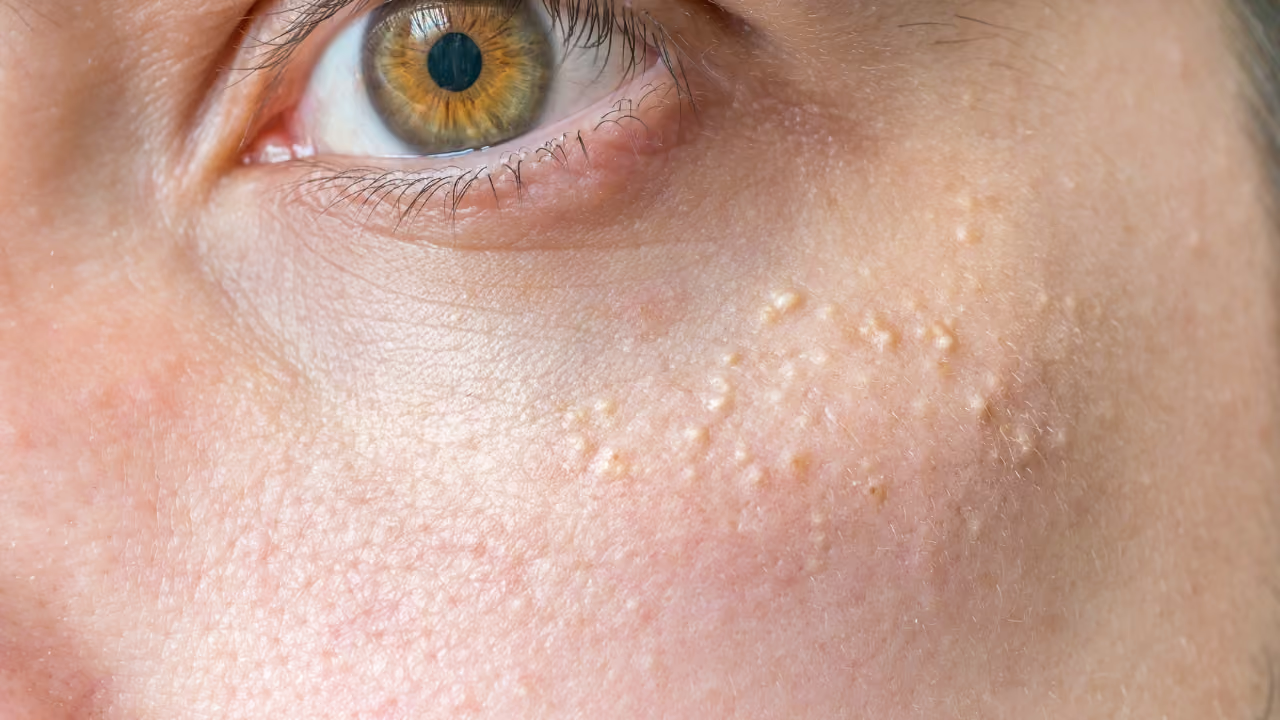
Milia are small, hard, white keratin cysts located just beneath the skin's surface. The singular form is milium; in Flanders, they are also known as 'gerstekorrels' or 'melkkorrels', and in English as 'milk spots'. Keratin becomes encapsulated in a tiny sac without an opening, making them stubborn and impossible to squeeze out. A milium is not the same as a blackhead: a blackhead is a clogged pore with a dark tip, whereas a milium is a closed keratin cyst. Also blackheads and pimples (acne) have a different cause and treatment.
Sebaceous cyst (atheroma)
A sebaceous cyst is a larger, benign bump in the skin, filled with a creamy white mass. It feels hard and movable and is loose under the skin. Colloquially, it is referred to as an 'atheroma' or 'sebum cyst', but the correct medical term is epidermoid cyst. On the scalp, it is almost always a pilar cyst (trichilemmal cyst): this type is firmer, has no visible punctum, and is more often familial. All types are benign.
Do you suffer from Benign cyst ?
Personalized advice for your skin, completely online. Upload a few photos through the Skindr app and receive medical advice from a licensed dermatologist within 48 hours. No waiting room or referral required.
How does a benign cyst develop?
How a benign cyst develops depends on the type. With milia, keratin accumulates just beneath the skin; with a sebaceous cyst, the duct of a sebaceous gland or hair follicle becomes blocked.
Milia (milk spots)
In newborns and babies milia are very common, especially on the nose and cheeks. They occur because keratin accumulates in superficial skin structures, as the skin is still fully developing. In babies, they disappear spontaneously within a few weeks to months and no treatment is needed. These are called primary milia.
In adults, secondary milia often develop in response to skin damage or stress: sun damage, burns, blisters, chemical peels, or laser treatments. Prolonged use of corticosteroid creams can also trigger milia. Risk factors include heavy or oil-based makeup and eye contour creams, infrequent exfoliation, and a genetic predisposition. In adults, milia rarely disappear on their own.
Sebaceous cyst (atheroma)
A sebaceous cyst forms when the duct of a sebaceous gland or hair follicle becomes blocked. Skin cells and sebum, which are normally expelled, accumulate in a cavity, thus forming the cyst. Risk factors include younger age, male gender (hormonal influence), a family predisposition, scarring, sun damage, and acne or clogged pores. Recurrent hair follicle inflammations also increase the risk of cyst formation. A sebaceous cyst is not cancerous, not inherently infectious, and not contagious; in most cases, it develops spontaneously without a clear cause.
Symptoms and characteristics of a benign cyst
A benign cyst is painless when at rest. Milia and sebaceous cysts look distinctly different, which is why we discuss them separately.
Milia (milk spots)
Milia are 1 to 3 mm hard, white or yellowish-white bumps that are slightly raised above the skin surface. They are firmly embedded in the skin and do not yield to pressure, meaning you cannot squeeze them out. There is no redness, pain, or inflammation unless they become irritated by friction. On darker skin, milia tend to appear yellowish or skin-colored rather than white. They most commonly occur around the eyes, on the cheeks, nose, and chin. Milia on the eyelid or directly under the eye are the most common reason people consult a dermatologist for this condition. If you're unsure whether it's milia or something else, such as molluscum contagiosum? A certified dermatologist will provide a diagnosis via Skindr within 48 hours.
Sebaceous cyst (atheroma)
A sebaceous cyst is recognizable as a round, smooth, firm yet slightly elastic lump directly under the skin, with a diameter ranging from a few millimeters to several centimeters. Sometimes a small black or white dot is visible in the center: the blocked duct. The contents consist of a creamy, cheese-like mass that can smell unpleasant if damaged. When at rest, the cyst is painless.
Possible complications
A sebaceous cyst can become inflamed. Signs of inflammation include redness, warmth, swelling, pain upon touch, pus or discharge, and sometimes fever. A severe inflammation can develop into an abscess and requires prompt treatment. If the cyst appears inflamed, do not wait. If you're unsure whether a lump is a sebaceous cyst, send a photo via Skindr: a certified dermatologist will review it within 48 hours.
Where do benign cysts occur?
Benign cysts primarily appear in areas with many sebaceous glands and hair follicles. The precise location varies by type, which also helps distinguish between the two forms.
Milia (milk spots)
Milia most commonly appear on the face: around the eyes, on the cheeks, nose, and chin. The thin skin around the eyes is a classic location. They can also occur on the chest, back, and genital area, but rarely on the arms or legs. In babies, the nose and cheeks are the most common spots.
Sebaceous cyst (atheroma cyst)
A sebaceous cyst most often occurs on the face (cheeks, neck, behind the ears), on the back and torso (upper back, shoulders, chest), on the scalp (usually as a pilar cyst here), and on the genitals (scrotum in men, labia in women). Less frequently, they appear on the arms and legs. Sebaceous cysts rarely occur on the palms of the hands and soles of the feet, as sebaceous glands are hardly present there.
Do you suffer from Benign cyst ?
Personalized advice for your skin, completely online. Upload a few photos through the Skindr app and receive medical advice from a licensed dermatologist within 48 hours. No waiting room or referral required.
Treatment of a benign cyst
A benign cyst that causes no symptoms does not always require treatment. Treatment is indicated for growth, discomfort, recurrent inflammation, or cosmetic concerns. The approach varies by type.
Treatment of milia
No treatment is needed for babies: milia disappear on their own within weeks to months. In adults, they rarely go away spontaneously. A certified dermatologist has safe techniques: the most common is a small sterile incision with a fine needle, after which the keratin plug is carefully removed. For multiple milia, a chemical peel or topical retinoids, under the guidance of a dermatologist, can help limit new formation. Around sensitive areas such as the eyelid, removal is done very carefully and manually. As a preventive measure, mild exfoliation with salicylic acid or glycolic acid can support skin renewal; additionally, use non-comedogenic cosmetics and avoid very rich eye creams.
Treatment of a sebaceous cyst
Squeezing or draining does not work: the cyst wall remains behind, and the cyst reforms, with an increased risk of infection. The only definitive treatment is surgical removal of the entire cyst wall. This is performed on an outpatient basis, under local anesthesia. For an inflamed cyst, the inflammation is first treated (draining and calming), only then followed by surgical removal. After complete removal, the chance of recurrence is small; after incomplete removal, such as squeezing, the cyst almost always returns.
When to see a dermatologist?
Consult a dermatologist for milia on the eyelid, if in doubt about what the bump exactly is (xanthelasma, syringoma, or molluscum contagiosum can resemble milia; a boil or lipoma can resemble a sebaceous cyst), for many lesions at once, or for a cyst that grows, causes discomfort, or becomes inflamed. An inflamed sebaceous cyst requires prompt attention. For reassurance: a benign cyst is not skin cancer.
Through Skindr, you will receive advice from a certified dermatologist within 48 hours. You submit a photo and will be informed if, and which, treatment is appropriate.
What doesn't work for a benign cyst?
Squeezing a benign cyst doesn't work. Milia are closed keratin cysts that don't yield to pressure, and with a sebaceous cyst, the cyst wall remains, causing the cyst to return. In both cases, you damage the skin and risk infection or scarring; around the eyes, this is even dangerous.
Self-pricking with a needle at home is not recommended for the same reason: it solves nothing and increases the risk of infection. Regular face cream or a moisturizing lotion has no effect because the cyst is deeper in the skin. Harsh scrubs cause additional skin damage and can even trigger new milia. Waiting is rarely effective for adults: unlike in babies, these cysts rarely disappear on their own. And an inflamed sebaceous cyst should never be left untreated; it requires prompt treatment.
Frequently asked questions about benign cysts
What is the difference between milia and a sebaceous cyst?
Milia (milk spots) are small, white keratin cysts, 1 to 3 mm in size, just under the skin, usually around the eyes. A sebaceous cyst is larger, movable, and filled with a sebum-like mass, often on the back, face, or torso. Both are benign.
Can you squeeze a benign cyst?
No. Milia do not yield to pressure, and with a sebaceous cyst, the cyst wall remains, causing the cyst to return. Squeezing damages the skin and can cause infection or scarring.
Is a benign cyst contagious?
No. Milia and sebaceous cysts are accumulations of keratin or sebum, not an infection. They are not contagious and are not a form of skin cancer.
Does a benign cyst disappear on its own?
In babies, milia disappear on their own within a few weeks to months. In adults, both milia and sebaceous cysts rarely disappear spontaneously; professional removal is then the best option.
When should I see a dermatologist for a benign cyst?
If you are unsure what the bump is, for milia around the eyes, for a cyst that is growing or bothering you, and certainly for signs of inflammation such as redness, pain, or pus.
Is the removal of a sebaceous cyst reimbursed in Belgium?
In Belgium, surgical removal of a sebaceous cyst is usually reimbursed by health insurance if there is a medical indication. Consult your dermatologist or general practitioner for the specific conditions.
Can Skindr help with a benign cyst?
Yes. You submit a photo, and a certified Skindr dermatologist assesses your situation within 48 hours, providing advice on the correct approach.


](https://static.legitscript.com/seals/624359.png)