.webp)


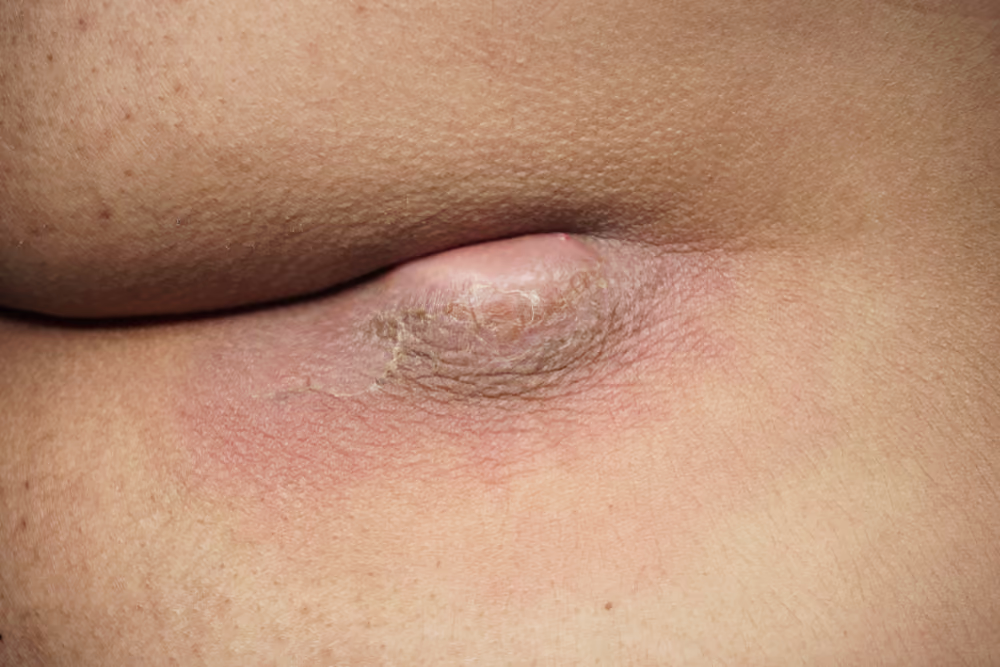
What is a pilonidal cyst?
A pilonidal cyst (sinus pilonidalis) is a chronic inflammation in the gluteal cleft where ingrown hairs and skin debris form a cavity or fistula under the skin. The common term "haarnestcyste" (hair nest cyst) refers to the nest of hair that accumulates in that cavity. The medical term sinus pilonidalis comes from the Latin "pilus" (hair) and "nidus" (nest).
The gluteal cleft is the narrow groove that runs from the tailbone (sacrum) towards the buttocks. Due to daily movement, friction, and pressure, loose hairs can bore through the skin like a needle. Once under the skin, they cause inflammation, leading to the formation of a cavity or channel (fistula). Interestingly: in about half of the cases, no hairs are found in the cavity at all. The inflammation is then purely caused by friction and pressure.
A pilonidal cyst has two stages. In a chronic pilonidal cyst, there is a small hole or dimple in the gluteal cleft, sometimes with slight discharge. Symptoms are mild and come and go. In an acute pilonidal abscess, there is a sudden accumulation of pus: the inflammation escalates into a swollen, throbbing lump with severe pain and often fever. This urgently requires medical advice and treatment by a doctor.
The condition affects men three to four times more often than women. The peak age is between 15 and 30 years. After that, the risk decreases, probably because hair growth becomes less dense and lifestyle changes. Factors such as overweight, a sedentary occupation, and heavy body hair increase the risk.
A common misconception: a pilonidal cyst is not a result of poor hygiene (see also the patient information from Gezondheid en Wetenschap). Even the most hygienic person can suffer from it. It is not caused by insufficient washing, but by anatomy, hair, and friction.
The ICD-10 classification is L05.0 (pilonidal abscess) or L05.9 (pilonidal cyst without abscess).
Do you suffer from Pilonidal cyst?
Personalized advice for your skin, completely online. Upload a few photos through the Skindr app and receive medical advice from a licensed dermatologist within 48 hours. No waiting room or referral required.
How does a pilonidal cyst develop?
A pilonidal cyst develops due to a combination of mechanical pressure, friction, and ingrown hair in the gluteal cleft. The mechanism proceeds in steps: loose hairs slide through the skin like a needle due to the movement of the buttocks, the body reacts with inflammation, a cavity forms with hair and debris, and with bacterial infection, this escalates into a painful abscess.
Risk Factors
Overweight is the strongest risk factor: a wider gluteal cleft and more friction together create a higher risk. Heavy body hair (and for some people also broader issues such as hair loss or changing hair growth) increases the chance of ingrown hairs, while a sedentary profession or lifestyle (desk work, long-distance driving) intensifies the constant pressure on the gluteal cleft. Young men between 15 and 30 years old are most at risk, partly due to hormonal influences on hair density.
Congenital predisposition and body build
A narrow, deep gluteal cleft makes the condition anatomically more likely. People with thick, dark, or curly hair are more often affected. A previously experienced pilonidal cyst also increases the chance of recurrence.
Not a hygiene issue
A pilonidal cyst has nothing to do with insufficient washing. The cause is mechanical, not bacteriological. However, bacteria can infect an existing cavity, after which the abscess develops.
If you notice skin problems in the gluteal region that resemble an abscess but you doubt whether it's a pilonidal cyst, a boil, or something else, a dermatological opinion can help correctly identify the condition. A related condition that also involves abscesses in skin folds is hidradenitis suppurativa (acne inversa).
Symptoms and characteristics of a pilonidal cyst
The symptoms of a pilonidal cyst vary greatly depending on the stage: dormant (chronic) or acute (abscess).
Chronic pilonidal cyst
In the dormant stage, you mainly notice a small hole or pit in the gluteal cleft, just above the tailbone. Sometimes there is a slight discharge of fluid or pus, a mild dull ache when sitting for long periods, and occasionally some odor. A fistula opening may be visible: a small opening in the skin. On both light and dark skin, the opening is visible as a fine pit in or next to the gluteal cleft. On dark skin, redness is less noticeable, but swelling and tenderness upon pressure are clearly present.
Acute pilonidal abscess
During an abscess flare-up, everything rapidly deteriorates: severe, throbbing pain makes sitting impossible, there is a warm, tense swelling just above the tailbone, the skin is red and sensitive, fever may occur (above 38°C), and eventually, the abscess may spontaneously rupture, discharging pus.
On light skin, the redness around the abscess is clearly visible. On dark skin, the discoloration is less pronounced: in that case, pay attention to the skin's texture (tense, shiny), warmth to the touch, and tenderness upon pressure.
When to seek immediate medical attention
Consult a doctor as soon as possible for an acute, painful abscess: self-incising is impossible and dangerous. Also see a doctor if you have a fever above 38°C combined with pain in the gluteal cleft, with suddenly rapidly increasing pain, or with a swelling that quickly grows larger.
Diagnosis by a doctor
A doctor makes the diagnosis based on visual inspection and palpation. A fistula opening in or next to the gluteal cleft is characteristic. Sometimes it is necessary to distinguish a pilonidal cyst from an anal fistula (which originates from the rectum) or a congenital sacral dimple (a skin dimple without inflammation). In doubtful cases, additional tissue examination via a skin biopsy give a definitive answer.
Where does a pilonidal cyst appear?
A pilonidal cyst is by definition located in the gluteal cleft: the groove running from the tailbone towards the buttocks. More precisely, the inflammation is in the subcutaneous fatty tissue just above the tailbone (sacrum). The fistula openings, the small holes in the skin, are located in or just next to the gluteal cleft.
Sometimes multiple fistula openings are present simultaneously, especially with a long-standing or recurrent pilonidal cyst. The opening can sometimes be difficult to see because it is hidden in the fold of the gluteal cleft.
In exceptional cases, pilonidal cysts can also occur in other locations: the navel, armpits, or even between the fingers (an occupational variant seen in hairdressers and veterinarians). These are rare variants that fall outside the usual scope.
The condition more often affects young men with dark, curly hair than women or men with finer hair. In women with a pilonidal cyst, the symptoms may sometimes be less pronounced, but the location remains the same.
Do you suffer from Pilonidal cyst?
Personalized advice for your skin, completely online. Upload a few photos through the Skindr app and receive medical advice from a licensed dermatologist within 48 hours. No waiting room or referral required.
Treatment of a Pilonidal Cyst
The treatment of a pilonidal cyst varies depending on the stage: an acute abscess requires prompt intervention, while chronic symptoms call for a definitive surgical approach.
Step 1: Draining an Acute Abscess
For an acute pilonidal abscess, incision and drainage under local anesthesia is the only effective acute treatment. The pus is relieved, the wound is left open, and cared for daily. Wound care is similar to that of other open wounds, such as in bedsores or an open leg wound. Antibiotics are not effective enough for a formed abscess: they do not reach the pus-filled cavity and do not solve the structural problem.
Step 2: Definitive Surgery
After abscess drainage, the pilonidal cyst often recurs if the underlying cavity is not removed. Definitive treatment options include surgical excision where the cavity is completely cut out and the wound is left open (longer healing but low recurrence rate), or a flap technique such as the Limberg flap or Karydakis procedure, where the wound is shifted away from the gluteal cleft (shorter recovery period, even lower recurrence rate).
Laser Treatment
Laser treatment (similar to the SiLaC protocol) is a less invasive option where the cavity is treated with a laser. There is no large open wound, recovery is faster, and time off work is limited. In Belgium, laser treatment is currently not reimbursed. The cost is approximately 400 euros (source: AZ Sint-Lucas Ghent, 2025).
Pit picking
For a pilonidal cyst that has not yet abscessed, pit picking can be considered: a minimally invasive technique where only the fistula openings are excised. The recurrence rate is higher than with excision, but the procedure is significantly less extensive.
Wound care and recovery
After an open excision, healing takes four to eight weeks, with daily wound care by a nurse. After flap or laser treatment, absence from work is limited to one to three weeks. Possible complications include secondary bleeding, wound infection, and slow healing. Warning signs after a procedure: fever, increasing pain at the wound site, or active bleeding.
Prevention and aftercare
Hair removal from the gluteal cleft, possibly with laser hair removal, significantly reduces the chance of recurrence. Weight management and avoiding prolonged sitting without a break are also helpful. Good hygiene and removing lint or skin flakes from the gluteal cleft are simple but effective prevention tips.
Recurrence
The recurrence rate after a simple excision is between 10 and 30%. Flap techniques and laser treatment show lower recurrence rates.
Through Skindr, you will receive advice from a certified dermatologist within 48 hours.
What doesn't work in the treatment of a pilonidal cyst?
For a pilonidal cyst, self-treatments are often attempted that either don't work or worsen the situation.
Squeezing or draining it yourself enlarges the infected area and increases the risk of a more severe abscess. Antibiotics alone do not solve the structural problem: they do not reach a pus-filled cavity and do not prevent recurrence. Ointments or creams on an abscess do not reach the cavity under the skin and waste valuable time. Waiting with an acute abscess is never a good idea: a pilonidal abscess rarely improves without intervention, and the longer you wait, the larger the cavity and infected area become. Excessive washing or scrubbing in the gluteal cleft irritates the skin and actually increases the risk of folliculitis.
For an acute, painful abscess: consult a doctor as soon as possible for drainage.
Frequently asked questions about a pilonidal cyst
Can a pilonidal cyst go away on its own?
This is rarely the case. A chronic pilonidal cyst may cause fewer symptoms during quiet periods but does not disappear on its own. An acute abscess always requires incision by a doctor. Definitive improvement requires surgical intervention to prevent recurrence.
Is a pilonidal cyst dangerous?
A pilonidal cyst is not life-threatening in itself, but an untreated abscess can spread and infect surrounding tissue. Early treatment shortens recovery time and significantly reduces the chance of recurrence.
How does a pilonidal sinus begin?
Typically as a small, painless dimple or hole in the gluteal cleft. Later, a fistula may develop with slight discharge. With the accumulation of hair and bacteria, this escalates into an acute, painful abscess. Early treatment is always simpler than waiting.
What should I do about a pilonidal cyst?
For an acute abscess: go directly to your GP or the emergency department for drainage. Self-treatment is ineffective. For chronic symptoms: consult a dermatologist or surgeon for a definitive approach, such as excision, laser treatment, or a flap technique.
How long does recovery take after a procedure?
After drainage: the wound improves in four to six weeks. After surgical excision: four to eight weeks. After laser treatment or flap technique: one to three weeks of absence from work. The exact recovery time depends on the chosen procedure and the type of wound.
Can a pilonidal cyst recur?
Yes, the recurrence rate after simple excision is between 10 and 30%. Flap techniques and laser treatment have a lower chance of recurrence. Preventive hair removal in the gluteal cleft and weight management help reduce recurrence.
Can Skindr help with a pilonidal cyst?
Yes, a certified Skindr dermatologist will assess your condition and refer you to the appropriate specialist (surgeon, proctologist). For an acute, painful abscess: go directly to your GP or the emergency department.
Resources
Sources:
- Skindr dermatologists (medical review)
- EBPNet / NHG guideline pilonidal sinus
- Gezondheid en Wetenschap.be: Pilonidal cyst (sinus pilonidalis)
- AZ Sint-Lucas Gent: Pilonidal sinus (updated February 2025)
- Thuisarts.nl: Inflammation in the gluteal cleft (sinus pilonidalis)
- DermNet NZ: Pilonidal sinus
- Huidziekten.nl: Pilonidal sinus



](https://static.legitscript.com/seals/624359.png)