.webp)


_2026-06-09_14-27-55.avif)
What is granuloma annulare?
Granuloma annulare is a benign skin condition in which small inflammatory foci (granulomas) take on a ring shape on the skin. The name refers precisely to this characteristic pattern: "granuloma" stands for the small inflammatory foci in the skin, "annulare" for the ring shape they form together.
Localized form
The localized form is the most common. In this form, one or a few rings appear on the hands, feet, elbows, or knees. This is the typical presentation in skin problems in children and young adults.
Disseminated (widespread) form
In the disseminated form, multiple rings spread across the torso, neck, or face. This form is more common in people over 40 years old and is sometimes linked to underlying conditions. Both forms are benign and never become malignant. The condition is not contagious and leaves no scars.
Do you suffer from Granuloma annulare?
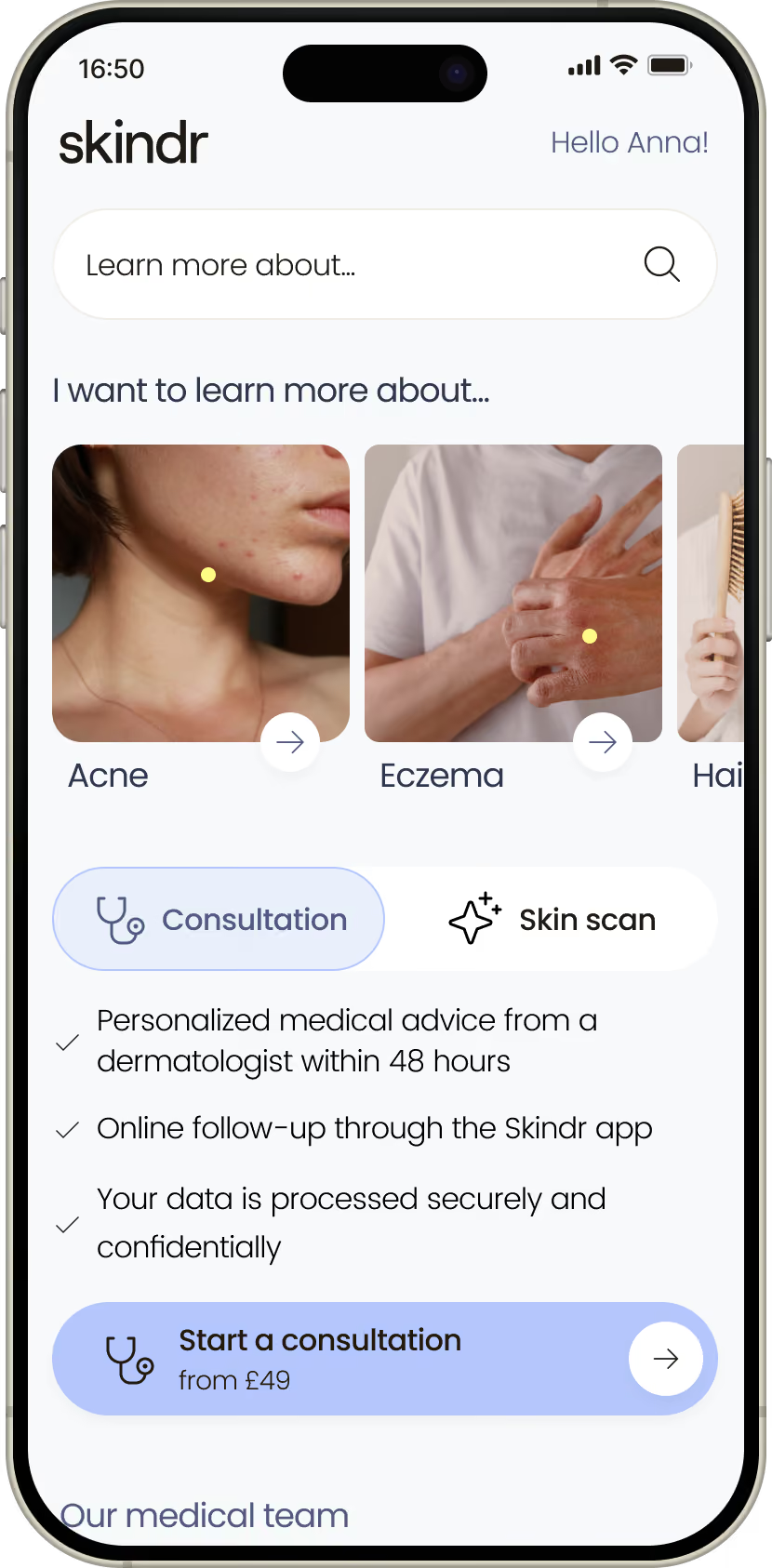
Personalized advice for your skin, completely online. Upload a few photos through the Skindr app and receive medical advice from a licensed dermatologist within 48 hours. No waiting room or referral required.
How does granuloma annulare develop?
The exact cause of granuloma annulare is not known. The immune system plays a central role: an abnormal reaction of certain immune cells causes the characteristic granulomas in the skin.
Possible trigger factors
Insect bites, vaccinations, and UV light exposure are linked by several sources to the occurrence or worsening of granuloma annulare. The exact relationship is not always proven.
Link with diabetes, cholesterol, and thyroid
In the disseminated form, elevated blood sugar or elevated cholesterol is sometimes found. Blood tests can be useful in such cases. In widespread forms, thyroid function is also sometimes checked. This does not mean that most patients have an underlying disease: the cause-and-effect relationship has not been proven, and most people with granuloma annulare do not have diabetes or a thyroid condition.
Symptoms and features of granuloma annulare
Granuloma annulare manifests as raised, ring-shaped lesions with a flesh-colored or light red border and a relatively smooth center. The ring slowly expands outwards and can grow several centimeters in size.
On light skin, the lesions are reddish or flesh-colored. On darker skin, they may have a purplish hue or be accompanied by hyperpigmentation, making them less easily recognized. Itching is rarely present.
Granuloma annulare is often confused with ringworm or fungal infection, but there are clear differences. Ringworm is a fungal infection that is itchier and responds to antifungal cream. Granuloma annulare is not a fungus, itching is rarely present, and the condition does not respond to antifungal cream. If antifungal cream has no effect after 2 to 3 weeks, granuloma annulare is a possible explanation. You can read more about ringworm on DermNet NZ.
A dermatologist can usually assess it visually. If there's any doubt, a biopsy (a small skin punch) can provide more clarity. Are you unsure whether it's granuloma annulare or ringworm? A certified Skindr dermatologist can assess your skin within 48 hours.
Where does granuloma annulare occur?
In the localized form, the rings most commonly appear on the hands, feet, elbows, and knees. These are also the areas most exposed to minor skin trauma. In the disseminated form, the lesions can also appear on the trunk, neck, and face.
Granuloma annulare can occur at any age, but the localized form is more common in children and young adults, while the disseminated form is more common in people over 40.
Do you suffer from Granuloma annulare?
Personalized advice for your skin, completely online. Upload a few photos through the Skindr app and receive medical advice from a licensed dermatologist within 48 hours. No waiting room or referral required.
Treatment of granuloma annulare
In most patients, granuloma annulare resolves spontaneously within 1 to 2 years, without treatment. Therefore, treatment is not always necessary, but may be considered for persistent or bothersome cases.
As a first choice, a local treatment on a doctor's advice is used. For stubborn individual lesions, intralesional injections may be given. For more severe cases, cryotherapy (freezing), phototherapy, or PUVA are among the available options. For severe disseminated forms, a dermatologist may consider systemic agents.
Notable fact: sometimes a skin biopsy (the small skin punch) already triggers a spontaneous improvement of the condition. This is not a treatment, but an observation that shows how unpredictable granuloma annulare can be.
There is no proven prevention for granuloma annulare. Avoiding unnecessary skin trauma can be beneficial.
Consult a dermatologist if you are unsure about the assessment, if spontaneous remission does not occur after 2 years, if it significantly impacts daily life, or if you suspect a malignant skin condition. Granuloma annulare typically does not leave scars or keloids behind. Through Skindr, you will receive advice from a certified dermatologist within 48 hours, without a referral from your GP.
What doesn't work for granuloma annulare?
The most common mistake is using antifungal cream for granuloma annulare. Because the spots are ring-shaped and resemble ringworm, many people reach for an antifungal cream. However, granuloma annulare is not a fungal infection: antifungal cream has no effect whatsoever on this condition.
Scratching or manipulating the spots also doesn't work: it causes skin trauma and can worsen the symptoms. Unproven folk remedies like vinegar or essential oils have no scientific evidence of efficacy and can irritate the skin.
A dermatologist can assess your skin and advise which treatments are useful and which are not.
Frequently asked questions about granuloma annulare
Is granuloma annulare contagious?
No, granuloma annulare is not contagious. It arises from a reaction of the body's own immune system and is not transmitted through skin contact.
Does granuloma annulare go away on its own?
Yes, in most patients, granuloma annulare disappears spontaneously within 1 to 2 years. In some cases, it returns later, but that too usually resolves on its own.
Is granuloma annulare related to diabetes?
In the generalized form, elevated blood sugar is sometimes found. A dermatologist may recommend blood tests, but most patients with granuloma annulare do not have diabetes.
How is granuloma annulare recognized?
A dermatologist usually assesses the condition visually. If there is any doubt, a skin biopsy the finding. Online assessment via Skindr is a quick first step, with no waiting list.
Is granuloma annulare dangerous?
No. Granuloma annulare is benign, never becomes malignant, and leaves no scars. In extensive cases, blood tests may sometimes be useful to rule out underlying conditions.
Can Skindr help with granuloma annulare?
Yes. Through Skindr, a certified dermatologist assesses your skin within 48 hours based on photos, without a referral from your GP. This way, you quickly get more clarity on whether it's granuloma annulare or something else.
Resources
Skindr certified dermatologists (www.skindr.com)
Huidziekten.nl: Granuloma annulare
Huidarts.com: Granuloma annulare
NVDV: Granuloma annulare
DermNet NZ: Granuloma annulare


](https://static.legitscript.com/seals/624359.png)