.webp)


What is pityriasis alba?
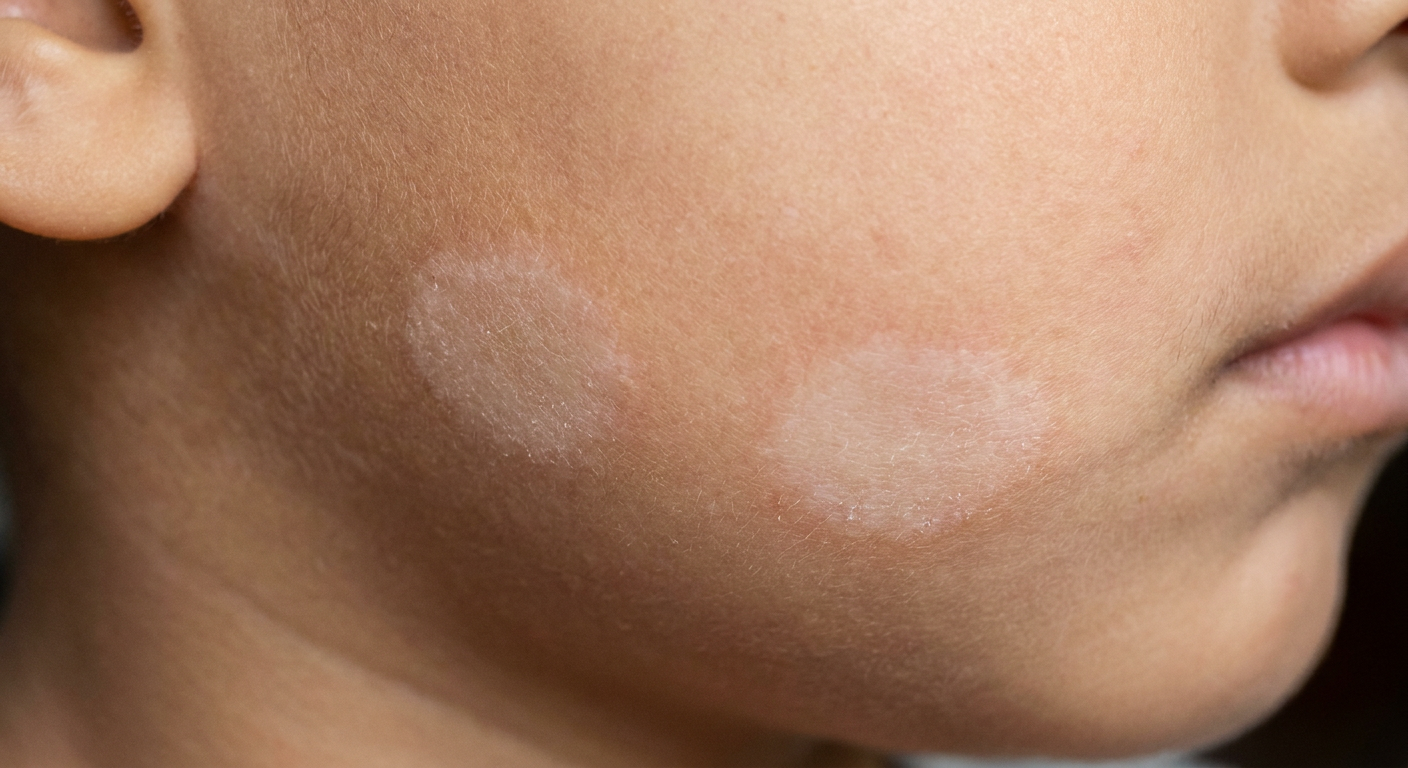
Pityriasis alba is a mild form of atopic skin inflammation (atopic eczema) that causes light, blurry patches on the skin. The condition is also known as summer eczema, pityriasis simplex, or impetigo furfuracea.
The light color of the patches is due to temporarily reduced pigment production. The skin inflammation inhibits the function of melanocytes (pigment cells). Once the inflammation subsides, pigmentation slowly recovers. It is not true pigment loss like in vitiligo, but a temporary phenomenon. Dermatological sources such as DermNet therefore describe pityriasis alba as a form of post-inflammatory hypopigmentation.
Pityriasis alba is completely harmless. In most children, the patches disappear spontaneously before the end of adolescence. Treatment is rarely medically necessary, although the recovery process can be supported.
Pityriasis alba is not contagious. It cannot be transmitted through touch, clothing, or contact. There is also no link to poor hygiene. The condition is more common in children with dry or atopic skin, but you don't need to have atopic eczema in children to develop pityriasis alba.
Do you suffer from Pityriasis alba?
Personalized advice for your skin, completely online. Upload a few photos through the Skindr app and receive medical advice from a licensed dermatologist within 48 hours. No waiting room or referral required.
How does pityriasis alba develop?
Pityriasis alba develops due to mild skin inflammation that temporarily reduces the activity of pigment cells. This inflammation is the same mechanism as in eczema, but in a very mild form.
The exact trigger point is not always identifiable. Dry air and cold dehydrate the skin and increase the likelihood of a mild inflammatory reaction. Sun exacerbates the visible contrast: the surrounding skin tans, while the spots remain light. This makes pityriasis alba most noticeable in summer, even though it was present throughout the winter.
There is no scientific evidence that diet, water, or hygiene play a role in the development of pityriasis alba. However, it is associated with very dry or eczematous skin. It is considered a mild form of atopic eczema. In essence, it is a mild post-inflammatory hypopigmentation, which can occur with any form of eczema.
Symptoms and characteristics of pityriasis alba
Pityriasis alba is characterized by vague, blurry light or white patches with indistinct borders. The patches are often slightly scaly and may itch mildly, but not necessarily. They are not raised and feel like the rest of the skin.
The typical course is temporal: the patches begin as pink or light red spots with fine scaling. After weeks to months, they fade and become lighter than the surrounding skin. In summer, the contrast is more noticeable because the rest of the skin tans, while the patches do not.
On darker skin types, the contrast is much greater, and the patches can be very prominent. This is not a more severe form of the condition, just more visible.
Is it pityriasis alba or something else?
Vitiligo causes bright white patches with sharp, clear borders. Pityriasis alba has vague, blurry edges. With a Wood's lamp the distinction is immediately clear to a certified dermatologist.
Pityriasis versicolor is a fungal skin infection that also causes light patches, but these are caused by a fungus. Pityriasis alba does not respond to antifungal treatment, whereas pityriasis versicolor does.
Are you unsure whether it's pityriasis alba or vitiligo? A certified Skindr dermatologist can make the distinction within 48 hours, without a referral.
Where does pityriasis alba occur?
Pityriasis alba most frequently appears on the face: the cheeks, forehead, and chin are the most affected areas in children. This also explains why parents notice the patches so quickly.
Additionally, the arms, neck, shoulders, and upper back can be affected. In cases of skin problems in children with dry or atopic skin, pityriasis alba can occur over a larger area. In adults, the patches are more often limited to the arms.
Pityriasis alba rarely occurs on the torso, abdomen, or legs. The condition prefers areas most exposed to sun and dry air.
Do you suffer from Pityriasis alba?
Personalized advice for your skin, completely online. Upload a few photos through the Skindr app and receive medical advice from a licensed dermatologist within 48 hours. No waiting room or referral required.
Treatment of pityriasis alba
Pityriasis alba usually does not require treatment. The spots disappear spontaneously, but this can take months to sometimes years. In most children, the spots are gone before the end of adolescence. In adults, the course can be longer. Reliable patient sources such as Health and Science confirm that pityriasis alba has a harmless and self-limiting course.
There are some treatment options that support the recovery process.
An emollient or rich cream is the foundation of any approach. Daily application keeps the skin hydrated and reduces the tendency for inflammation.
A mild corticosteroid cream (hydrocortisone 1%) can calm the inflammation and speed up recovery. This should be used for a short period under the guidance of a dermatologist.
Sunscreen with a high protection factor (SPF 50+) on the affected areas and on the surrounding skin is the most important preventive measure. It prevents the contrast from becoming more pronounced in the summer.
For extensive forms, a dermatologist may consider light therapy (narrowband UVB) for children older than 12 years.
A certified dermatologist should be consulted if there is doubt about the condition (to rule out vitiligo), in cases of widespread distribution, if the spots are very bothersome, or if there is no improvement after basic treatment.
Through Skindr, a certified dermatologist assesses the spots based on photos within 48 hours. This way, you quickly find out if it's pityriasis alba and what steps you can take.
What doesn't work against pityriasis alba?
Antifungal creams or shampoos do not work for pityriasis alba. Pityriasis alba is not a fungal infection, but a mild atopic skin inflammation. If there is no improvement after antifungal treatment, this is an indication that it is pityriasis alba or another condition.
Intensive scrubbing or harsh exfoliation worsens the skin and the tendency for inflammation. This is especially true for children with dry or atopic skin.
Using a tanning bed to blend the spots is counterproductive. Tanning beds increase the contrast and damage the skin.
Patience and daily hydration are fundamental. Sunscreen (SPF 50+) is the only active preventive measure.
Frequently asked questions about pityriasis alba
Does pityriasis alba go away on its own?
Yes, in most children. The spots disappear spontaneously, but this can take months to years. In most children, they are gone before the end of adolescence.
What is the difference between pityriasis alba and vitiligo?
Pityriasis alba causes faint, hazy light patches with indistinct borders. Vitiligo causes bright white patches with sharp boundaries and a true absence of pigment. A dermatologist confirms the distinction with a Wood's lamp.
Is pityriasis alba caused by a fungus?
No. Pityriasis alba is not a fungal infection. Antifungal treatment has no effect.
Can I apply sunscreen to my child?
Yes, absolutely. High SPF sunscreen on the affected patches and the surrounding skin prevents the contrast from increasing. Use SPF 50+ on the face and arms.
Can pityriasis alba occur in adults?
Yes, although it is much more common in children. In adults, the patches are more often on the arms. The course is similar: slow spontaneous improvement.
Is pityriasis alba contagious?
No. Pityriasis alba is an immune system reaction and cannot be transmitted through touch or contact.
Can Skindr help with pityriasis alba?
Yes. Through Skindr, a certified dermatologist assesses the patches within 48 hours. This is useful if you want to know whether it's pityriasis alba or another condition like vitiligo.


](https://static.legitscript.com/seals/624359.png)