.webp)


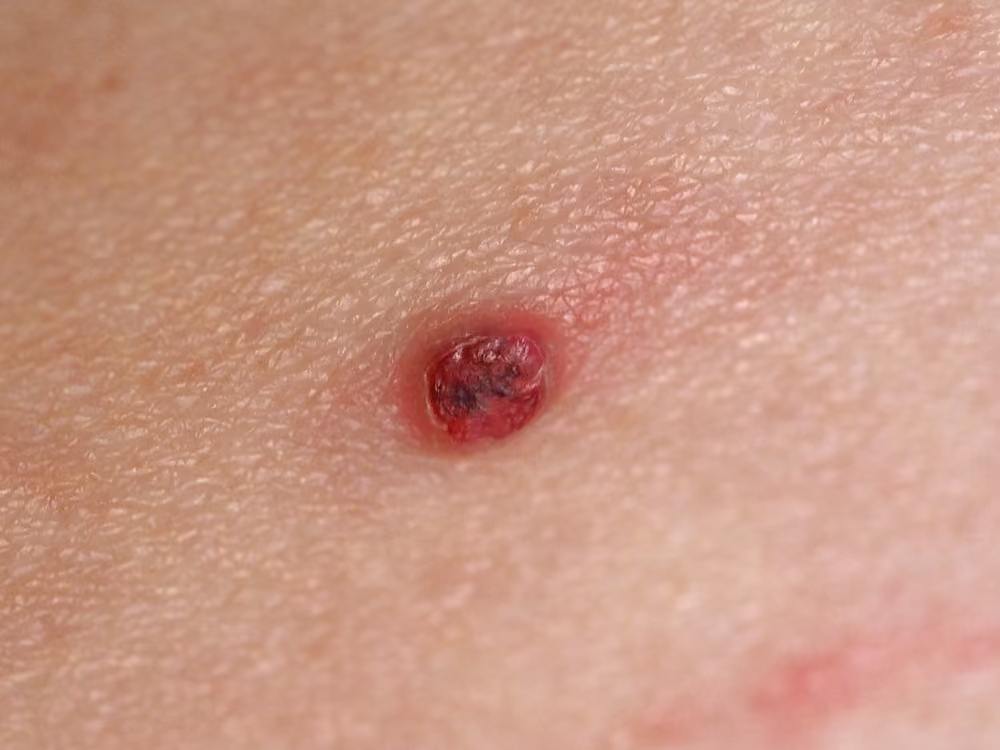
What is a pyogenic granuloma?
A pyogenic granuloma is a benign, fast-growing lesion composed of blood vessels in the skin. It bleeds easily, sometimes heavily, at the slightest touch. The name is historically confusing: it is not a true infection (not pyogenic) and not a true granuloma. It is simply an excessive growth of blood vessels after minor skin irritation. You can find more medical background at DermNet.
Other names: granuloma pyogenicum and granuloma teleangiectaticum
The condition is also known as granuloma pyogenicum (the commonly used medical Latin name) and granuloma teleangiectaticum (a more accurate term referring to the vascular structure). In everyday use, these terms are used interchangeably.
Children, young adults, and pregnant women most frequently develop pyogenic granuloma, but it can occur at any age.
Do you suffer from Pyogenic granuloma?
Personalized advice for your skin, completely online. Upload a few photos through the Skindr app and receive medical advice from a licensed dermatologist within 48 hours. No waiting room or referral required.
How does a pyogenic granuloma develop?
The precise cause is not fully understood, but minor skin trauma appears to be the trigger in many cases. A splinter, a small wound, an abrasion, or chronic irritation can initiate blood vessel growth.
In pregnant women, hormonal changes play a role: a pyogenic granuloma then develops spontaneously and sometimes shrinks back on its own after childbirth. This is also known as a "pregnancy granuloma" or "pregnancy tumor."
Certain medications can also play a role: cyclosporine and some other treatments have been described as causes. Growth from nothing to full size typically occurs within 2 to 6 weeks.
Symptoms and characteristics of a pyogenic granuloma
A pyogenic granuloma appears as a red to purplish-red, shiny, slightly raised bump. A collar-like skin rim is sometimes visible around its base. Its size ranges from a few millimeters to 2 centimeters. The most characteristic and alarming symptom is how easily it bleeds: the slightest touch, a washing motion, or an article of clothing can provoke significant bleeding.
On darker skin, the color may sometimes be less visible and less red. Bleeding upon touch is then the most important sign.
An amelanotic melanoma (a rare form of skin cancer without pigment) can look similar. For this reason, any rapidly growing, bleeding bump should be evaluated by a doctor. A Skindr dermatologist can make an initial assessment of a melanoma or malignant lesion, or distinguish it from a common mole or pigmented lesion.
Where does a pyogenic granuloma occur?
A pyogenic granuloma most commonly occurs on the fingers, hands, lips, and nose, and on the face in general. In children, it is more common on the head and neck than in adults. It can also appear on the upper body.
A particular location is the gums or oral cavity, especially in pregnant women: this is called a pregnancy epulis or epulis granulomatosa and falls under the purview of a dentist or oral and maxillofacial surgeon. You can read more about this at skin conditions and the mouth.
Do you suffer from Pyogenic granuloma?
Personalized advice for your skin, completely online. Upload a few photos through the Skindr app and receive medical advice from a licensed dermatologist within 48 hours. No waiting room or referral required.
Treatment of a Pyogenic Granuloma
A pyogenic granuloma rarely disappears on its own in adults and requires professional treatment. The most common method is curettage combined with electrocoagulation: under local anesthesia, the tissue is scraped away and the base is cauterized to stop bleeding and reduce recurrence. Excision with sutures is an alternative, especially if there is diagnostic doubt about the nature of the growth.
For small, early lesions, less invasive options such as silver nitrate application or cryotherapy are sometimes applicable.
After removal, the tissue is routinely sent for pathological examination so that melanoma can be definitively ruled out. Reliable patient information about benign skin growths can also be found at Health and Science.
Recurrence after treatment occurs in 10 to 16% of cases. Home self-care: cover the growth with a plaster, do not touch it, and if bleeding occurs, apply firm pressure for 5 to 10 minutes. Do not wait too long: for a bleeding, rapidly growing bump, a dermatologist visit within 2 to 4 weeks is advisable. The removed tissue can be examined via a skin biopsy . Through Skindr, you will receive advice from a certified dermatologist within 48 hours, so that skin cancer can be ruled out can be done quickly and easily.
What doesn't work against a pyogenic granuloma?
Touching, scratching, or manipulating the growth is dangerous: it bleeds heavily, and the risk of infection increases. Tying it off at home with a thread or elastic band is a particularly risky method that causes incomplete removal, tissue damage, and infection. Self-removal with a needle or blade carries a risk of bleeding and makes pathological examination impossible.
Waiting it out also doesn't work well: in adults, a pyogenic granuloma rarely shrinks spontaneously. Antifungal cream or antibiotic ointment has no effect whatsoever, as it is not an infection or fungal condition.
Frequently Asked Questions about Pyogenic Granuloma
What is a pyogenic granuloma?
A pyogenic granuloma is a benign, fast-growing vascular growth on the skin that bleeds heavily when touched. It is not malignant but should always be assessed by a doctor.
Does a pyogenic granuloma go away on its own?
In pregnant women, it sometimes shrinks spontaneously after childbirth. In children and adults, it rarely disappears on its own, and professional treatment is needed.
Is a pyogenic granuloma dangerous?
It is benign and does not spread. However, it can outwardly resemble an amelanotic melanoma. Any fast-growing, bleeding bump should always be assessed by a dermatologist.
How is a pyogenic granuloma treated?
Curettage with electrocoagulation is the most common method. Excision is an alternative. Tissue is always examined via pathological investigation to rule out malignancy.
Can it recur after treatment?
Yes, in 10 to 16% of cases. A second treatment is then needed.
Can Skindr help with a pyogenic granuloma?
Yes. You send a photo of the growth, and a certified Skindr dermatologist will provide advice within 48 hours, including on the urgency of a physical visit.


](https://static.legitscript.com/seals/624359.png)