.webp)


What are genital warts?
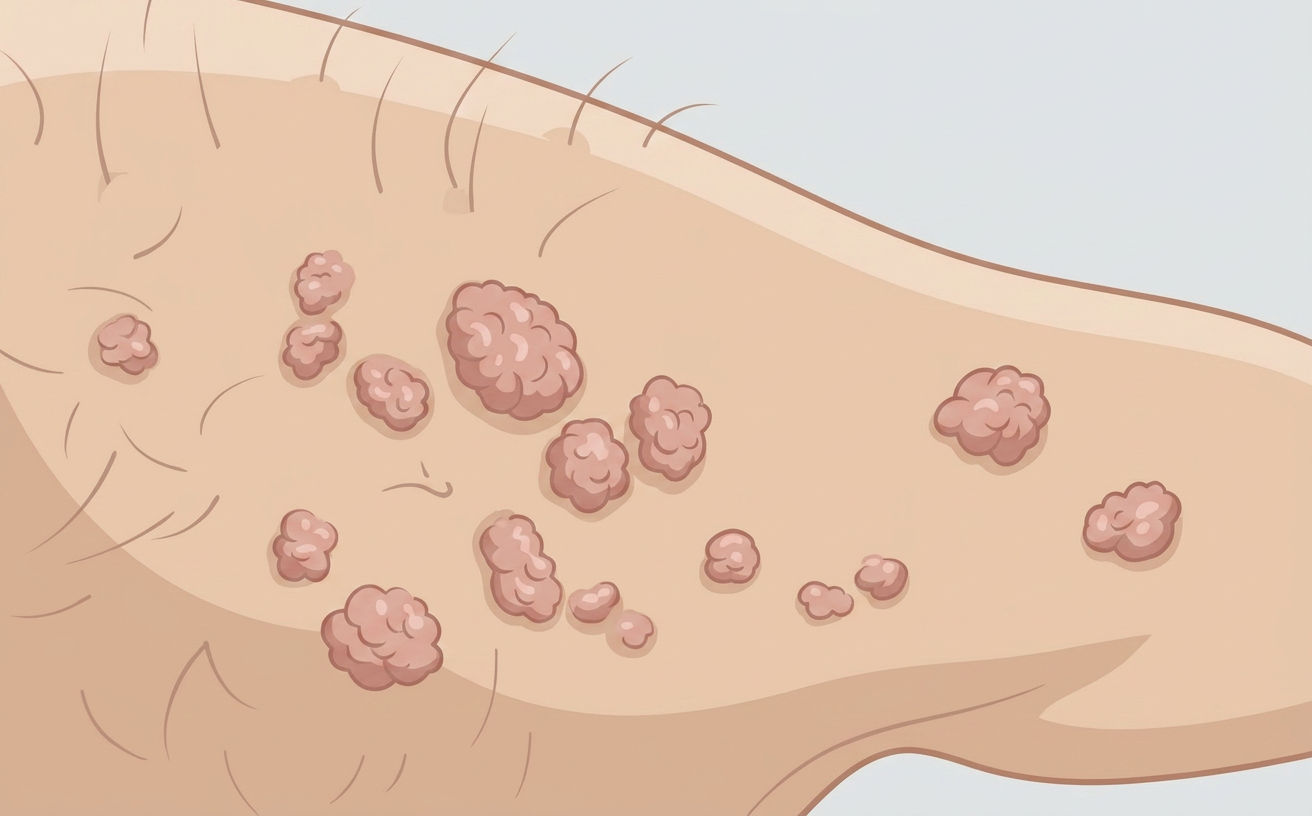
Genital warts, medically known as condylomata acuminata, are small flesh-colored or pink growths on or around the genitals, caused by the human papillomavirus (HPV). Genital warts are the most common viral sexually transmitted infection.
An important reassurance: genital warts are caused by HPV types 6 and 11. These are different types than HPV 16 and 18, which are linked to cervical cancer and skin cancer. Genital warts do not become malignant and do not pose a cancer risk.
Not every bump in the genital area is a genital wart. Fordyce spots are harmless, light-yellow sebaceous glands that commonly appear on the labia or penile shaft. Pearly penile papules are small, regularly arranged bumps around the glans of the penis, a normal anatomical variant. Genital warts also clearly differ from molluscum contagiosum and from common warts on hands and feet, which are caused by other HPV types and have a different transmission route.
If you are unsure about what you see, an assessment by a certified dermatologist is the quickest way to certainty. Through Skindr, you can receive this assessment based on photos, within 48 hours and without a referral.
Do you suffer from Genital warts?
Personalized advice for your skin, completely online. Upload a few photos through the Skindr app and receive medical advice from a licensed dermatologist within 48 hours. No waiting room or referral required.
How do genital warts develop?
Genital warts develop through the transmission of the human papillomavirus (HPV) via skin-to-skin contact during sexual activity. Penetration is not required: anal sex, orogenital contact, or direct genital contact can also cause infection. A condom significantly reduces the risk but does not offer complete protection because HPV can be present on skin areas outside the condom-covered area.
The incubation period ranges from a few weeks to two years, with an average of two to three months. This explains why warts can appear even without a recent new partner. Someone can carry HPV without having visible warts themselves (asymptomatic carriage), and thus unknowingly transmit the infection.
More than 50 percent of sexually active people will come into contact with HPV at some point, as also Thuisarts.nl An increased risk exists for individuals with a weakened immune system, smoking, multiple sexual partners, or an early sexual debut. The sooner the immune system recognizes and tackles HPV, the smaller the chance that warts will develop.
Genital warts are a different condition than genital herpes, which is accompanied by painful blisters, fever-like symptoms, and burning pain. Also, chlamydia is a common sexually transmitted infection that can be confused with or occur simultaneously with genital warts. If there is any doubt about which condition is present, a dermatological examination is advisable.
Symptoms and Characteristics of Genital Warts
Genital warts are small, flesh-colored or pink bumps that appear individually or cluster together in cauliflower-like formations. They can be smooth or slightly rough and range from barely visible to several millimeters in diameter. In rare cases, clusters can grow to cover a larger area, especially with a severely weakened immune system.
On light skin tones, they are recognizable as flesh-colored or light pink raised lesions. On darker skin tones, genital warts may appear a slightly darker or grayer color, making them less contrasting. In both cases, the cauliflower-like or rough texture is an important distinguishing feature.
Genital warts are usually painless. Sometimes, mild itching, a burning sensation, or minimal bleeding may occur after friction. Internal warts, located in the vagina, on the cervix, or in the anal canal, are not visible during self-examination and are discovered during gynecological or dermatological examination.
Warning signs requiring prompt medical evaluation include: rapid growth of the warts, persistent pain or bleeding, a bump in an unusual location such as the mouth or throat, or concurrent symptoms such as fever or discharge that may indicate an additional infection.
Where Do Genital Warts Occur?
In men, genital warts appear on the shaft of the penis, the glans margin, the foreskin, and the scrotum, as well as in the groin and around the anus. In women, they are found on the labia minora and majora, the vaginal opening, and the cervix. In both men and women, the perianal area is a frequent location, even in individuals who have not engaged in anal sex: HPV can spread to this area through other contact routes.
Following orogenital contact, genital warts can, in rare cases, appear on the lips, tongue, or in the throat. These are known as buccal or oropharyngeal condylomata.
During pregnancy, existing warts may grow more rapidly due to hormonal changes and an altered immune response. In exceptional cases, the virus can be transmitted from mother to child during childbirth. For this reason, it is advisable to always have genital warts assessed by a doctor during pregnancy.
Do you suffer from Genital warts?
Personalized advice for your skin, completely online. Upload a few photos through the Skindr app and receive medical advice from a licensed dermatologist within 48 hours. No waiting room or referral required.
Treatment of Genital Warts
Genital warts are treatable. The most effective approach depends on the number of warts, their location, size, and your personal preference and situation.
Topical Ointments From a Doctor or Pharmacist
Topical ointments from a doctor or pharmacist are the most common first step in treatment. They work through two mechanisms: some stimulate the immune system to combat the HPV virus, while others directly damage the wart cells. They are applied over a course of several weeks and require consistent application. A dermatologist will recommend the appropriate product based on the location and condition of the skin.
Treatments by a Dermatologist
Cryotherapy (freezing with liquid nitrogen) is the most common treatment performed by dermatologists in practice. The wart is frozen and dies off. Multiple sessions are often required. Laser, electrocautery, or surgical removal are options for extensive or stubborn cases, such as DermNet NZ describes. A certified dermatologist assesses which technique is suitable and refers to the appropriate specialist when necessary.
Spontaneous Disappearance and Prevention
With a strong immune system, genital warts can sometimes disappear on their own, typically after one to two years. Treatment significantly speeds up this process and simultaneously reduces the risk of further transmission to a partner.
Genital warts and pregnancy: some treatments are not safe during pregnancy. Always discuss treatment options with a doctor if you are pregnant or considering pregnancy.
HPV vaccination protects against types 6 and 11, which are responsible for most genital warts. Vaccination works best for people who have not previously been exposed to HPV and is most effective before the onset of sexual activity. More information about HPV vaccination can be found at huidziekten.nl.
Through Skindr, you will receive advice from a certified dermatologist on the correct next step within 48 hours, without a referral from your GP.
What doesn't work against genital warts?
Over-the-counter creams or plasters for common warts on hands or feet are not suitable for the genital area. They typically contain salicylic acid in a concentration that can cause severe irritation and tissue damage to the sensitive genital skin. Never use these products on the genitals, even if the packaging does not explicitly prohibit it.
Scratching, breaking open, or attempting to remove them yourself increases the risk of spreading the warts to other skin areas and raises the chance of a secondary bacterial infection.
Waiting is not advisable if you experience pain, persistent bleeding, rapid growth of the warts, or during pregnancy. In these situations, prompt dermatological assessment is necessary.
Not informing a partner while you have active genital warts increases the risk of unconscious HPV transmission.
Frequently Asked Questions about Genital Warts
Are genital warts contagious?
Yes, through skin-to-skin contact during sexual activity. HPV can also be transmitted even without visible warts. A condom significantly reduces the risk but does not offer complete protection.
Do genital warts go away on their own?
Sometimes. With a strong immune system, they usually disappear on their own within one to two years. Treatment significantly speeds this up and lowers the risk of transmission to your partner.
Can genital warts cause cervical cancer?
No. Genital warts are caused by HPV types 6 and 11. These are different types from HPV 16 and 18, which are linked to cervical cancer. Genital warts do not become malignant.
Does a condom offer complete protection?
Not completely. HPV can be present on skin areas outside the condom-covered region, such as the labia, groin, or scrotum. Condoms significantly reduce the risk but do not offer one hundred percent protection.
Does HPV vaccination help against genital warts?
Yes. HPV vaccination also protects against types 6 and 11. It works best for people who have not yet been exposed to HPV. Ask your doctor about the options.
Should I inform my partner?
Yes. Genital warts are transmissible, even without visible warts. Informing your partner gives them the opportunity to get tested and, if necessary, treated.
When should I see a dermatologist?
If you are unsure about the assessment, experience pain or bleeding, notice rapid growth, if warts return after treatment, or during pregnancy.
Can Skindr help with genital warts?
Yes. Through Skindr, a certified dermatologist assesses your situation based on photos and provides advice within 48 hours, including a referral if necessary. No GP referral is required.



](https://static.legitscript.com/seals/624359.png)