.webp)


What is Hypostatic Eczema?
Hypostatic Eczema is a type of eczema that develops on the lower legs in people with reduced blood drainage through the leg veins. You may also hear the names stasis eczema, varicose eczema (because it often occurs with varicose veins) or the medical term stasis dermatitis. The skin on the lower legs becomes red, dry, and scaly, and often itches severely.
The condition is associated with chronic venous insufficiency (CVI): a condition where the veins inadequately transport blood from the legs back to the heart. This leads to increased pressure in the leg veins and can cause fluid to accumulate in the lower legs (edema). Stasis eczema primarily affects older people and is slightly more common in women. It is usually located around the ankles and on the lower legs.
Stasis eczema is not contagious. It is often a chronic condition because the underlying venous insufficiency usually does not resolve on its own. With the right treatment, especially with compression therapy (support stockings), skin complaints can usually be kept well under control. When the underlying cause, such as varicose veins, is successfully treated, the eczema can significantly improve or even disappear in many cases.
Do you suffer from Hypostatic eczema?
Personalized advice for your skin, completely online. Upload a few photos through the Skindr app and receive medical advice from a licensed dermatologist within 48 hours. No waiting room or referral required.
How does stasis eczema develop?
Stasis eczema is caused by chronic venous insufficiency (CVI), a condition in which blood is inadequately drained from the legs via the veins. Normally, the calf muscles ensure that blood is pumped against gravity towards the heart, while valves in the veins prevent it from flowing back. If these valves function inadequately, blood reflux occurs, and pressure in the leg veins increases.
Due to this increased pressure, fluid and pro-inflammatory substances leak from the blood vessels into the surrounding tissue. This causes an inflammatory reaction that manifests on the skin as eczema. Prolonged standing or sitting can worsen the congestion, while movement, such as walking, cycling, and swimming, supports the drainage of blood from the legs.
Risk factors for chronic venous insufficiency and stasis eczema include older age, varicose veins, obesity, a history of deep vein thrombosis, lymphedema, and a history of radiation therapy. Pregnancy and hormonal factors can also contribute to the development of venous insufficiency.
Contact allergy due to ointments and stockings
Individuals with long-term stasis eczema have an increased risk of developing a contact allergy to components of ointments, creams, dressings, or compression materials. As a result, in addition to stasis eczema, an allergic contact eczema can develop. Keep this in mind if symptoms persist or worsen despite treatment. In such cases, additional tests, such as patch tests, may be useful to detect a contact allergy.
Symptoms and characteristics of stasis eczema
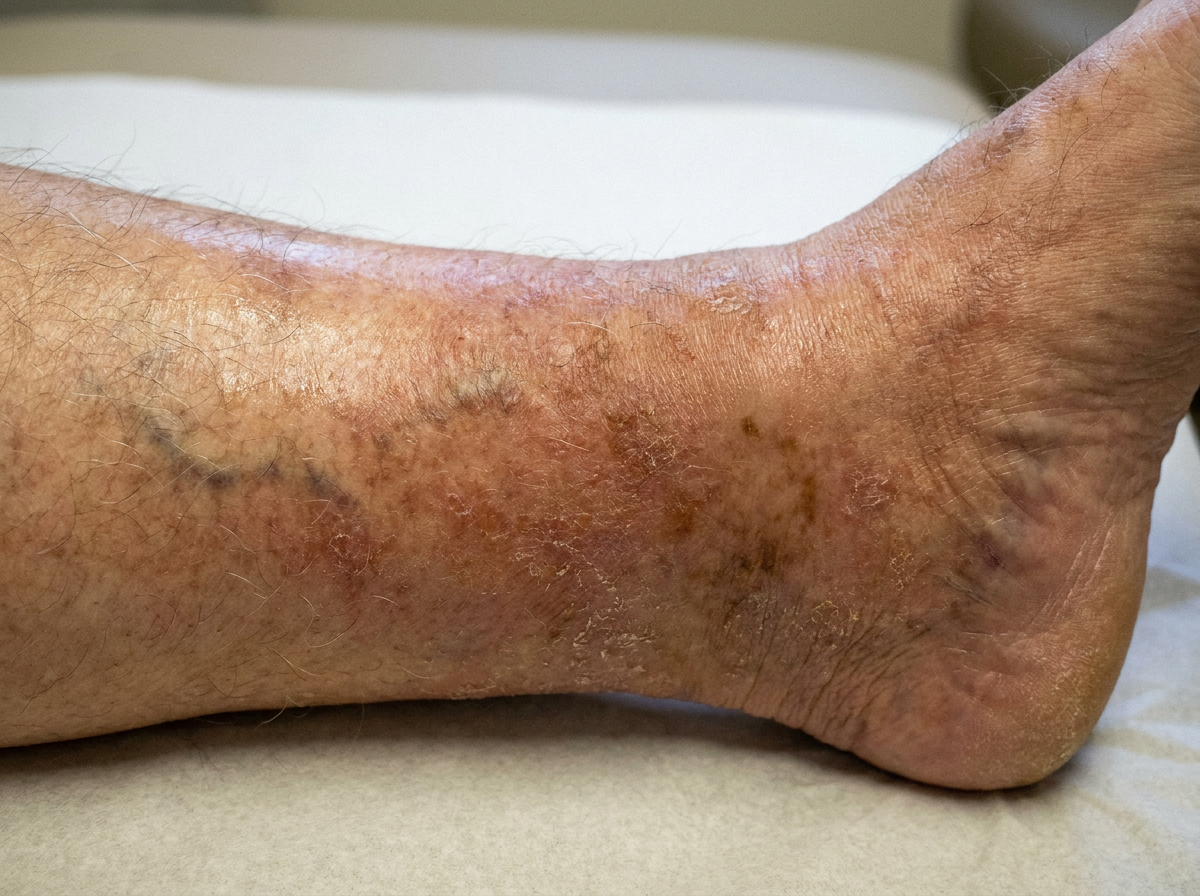
Stasis eczema manifests as poorly defined, red, and scaly patches on the lower legs, usually around the ankles. The skin often itches severely, which can lead to scratch marks. Sometimes the skin is weeping, and crusts may form.
In addition to the eczema, there are often signs of chronic venous insufficiency, such as varicose veins, swollen ankles (edema) and brownish discolorations of the skin due to the deposition of iron-containing pigment (hemosiderin). The edema can also cause compressible pitting, for example, where socks have been.
In a more advanced stage, atrophie blanche (small, shiny white, scar-like spots) and ulcus cruris venosum (venous leg ulcer) can occur.
What does hypostatic eczema look like on different skin tones?
On light skin, the redness of hypostatic eczema is usually quite noticeable. On darker skin, redness may be less visible, and the skin may appear more purplish-brown, dark brown, or grayish. The brown discolorations due to iron deposition (hemosiderin) can also sometimes be harder to recognize on darker skin. Therefore, pay attention not only to color changes but also to other characteristics such as swelling (edema), itching, scaling, and thickened or irritated skin.
When to worry?
Hypostatic eczema can resemble other skin conditions, such as nummular eczema, contact eczema, or a skin infection. Sometimes, a skin infection also develops on top of the existing eczema.
If you suddenly develop a bright red, warm, painful, and rapidly spreading patch on your lower leg, possibly accompanied by fever or a general feeling of illness, seek medical attention the same day. This could indicate a skin infection.
If an open wound (ulcer) develops on your lower leg, have it assessed by a doctor. Are you unsure about your symptoms? A certified dermatologist will assess your skin via Skindr within 48 hours based on a few photos.
Where does hypostatic eczema occur?
Hypostatic eczema almost always affects the lower legs, especially around the ankles and on the lower leg. This is where venous pressure is highest and congestion is most severe. The feet are usually spared.
The condition can occur in one or both legs. Over time, the other leg may also become involved if chronic venous insufficiency develops there as well. Sometimes, eczema patches also appear on other parts of the body. This is usually the result of a so-called disseminated reaction (eczematid) or from an additional contact allergy.
If stasis eczema persists for a long time, a slow-healing wound can develop on the lower leg. This is then referred to as a venous leg ulcer or open sore. This is an important reason to treat stasis eczema promptly.
Do you suffer from Hypostatic eczema?
Personalized advice for your skin, completely online. Upload a few photos through the Skindr app and receive medical advice from a licensed dermatologist within 48 hours. No waiting room or referral required.
Treatment of Stasis Eczema
The treatment of stasis eczema focuses on two goals: improving blood flow in the legs and calming the skin. Addressing the underlying venous insufficiency is essential, as symptoms often recur otherwise.
Compression: The Basis of Treatment
Compression therapy is the cornerstone of treatment. If there is significant swelling, the leg is often bandaged for several weeks first. Afterward, elastic compression stockings are fitted. These improve blood flow and reduce edema. Wear the stockings daily, even in warm weather. Additionally, exercise regularly, elevate your legs when sitting for extended periods, avoid tight clothing, and try to maintain a healthy weight.
Skin Care and Medical Treatment
Apply a rich, fragrance-free cream to the skin daily to prevent dryness. During an active flare-up, a doctor may temporarily prescribe a corticosteroid cream to reduce inflammation and itching. If a skin infection develops, additional treatment may be necessary. Treating underlying varicose veins can often significantly improve or even resolve the eczema.
When to See a Dermatologist?
Consult a doctor or dermatologist if symptoms do not improve sufficiently, keep recurring, if signs of infection appear, or if a slow-healing wound or an open sore develops. Through Skindr, you will receive advice from a certified dermatologist within 48 hours based on a few photos. If a physical examination or additional vascular assessment is needed, you will be referred accordingly.
What Doesn't Work for Stasis Eczema?
Only caring for the skin or exclusively using a corticosteroid cream without addressing the underlying venous insufficiency usually provides only temporary relief. Without compression therapy, the increased pressure in the leg veins persists, causing symptoms to often recur.
Antibiotics do not help against stasis eczema itself, as it is not an infection. However, the condition is sometimes confused with a skin infection, leading to unnecessary antibiotic prescriptions. Antibiotics are only indicated when there is an actual concomitant bacterial infection.
Another common mistake is not wearing compression stockings on warm days. Although compression stockings may feel less comfortable then, they are crucial for preventing fluid retention and worsening of symptoms.
Do symptoms persist despite treatment? If so, do not constantly switch ointments or creams on your own initiative. With long-term stasis eczema, a contact allergy can develop to ingredients in ointments, creams, dressings, or compression materials. This can actually worsen skin symptoms instead of improving them. In that case, further investigation into a possible contact allergy is advisable.
Frequently Asked Questions about Stasis Eczema
Is stasis eczema contagious?
No, stasis eczema is not contagious. It's not an infection, but rather a result of reduced blood flow in the veins of the legs. You cannot pass it on to others.
What causes stasis eczema?
The cause is chronic venous insufficiency: reduced blood flow in the leg veins. This increases pressure in the blood vessels, causing fluid to leak into the tissue and leading to inflammation that manifests as eczema.
Do compression stockings really help with stasis eczema?
Yes. Compression with stockings is the cornerstone of treatment. They improve blood flow and reduce swelling, which helps calm the eczema. Wear them every day, even in warm weather.
Can stasis eczema be cured?
The skin symptoms can usually be well controlled with compression therapy and skincare. The underlying venous insufficiency usually doesn't disappear on its own. When a treatable cause, such as varicose veins, is addressed, the eczema can significantly improve or sometimes disappear completely.
Is stasis eczema dangerous?
Not in itself, but if left untreated, long-standing stasis eczema can lead to an open leg ulcer (a persistent wound). If there are signs of infection, such as rapidly spreading redness, warmth, and fever, seek help the same day.
When should I see a dermatologist for stasis eczema?
If symptoms don't improve, keep recurring, if there are signs of infection, or if there's an open wound on the lower leg. Through Skindr, you'll receive an assessment from a certified dermatologist within 48 hours.
Can Skindr help with stasis eczema?
Yes. You upload a few photos and a description of your symptoms, and a certified dermatologist will assess your skin within 48 hours, without a waiting room or referral. If a vascular examination is needed, we will provide a targeted referral.


](https://static.legitscript.com/seals/624359.png)