.webp)


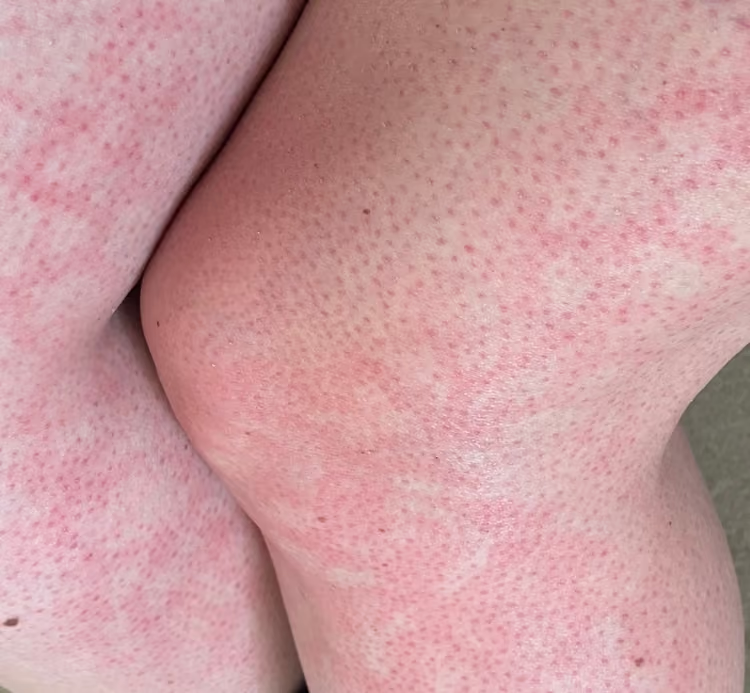
What is livedo reticularis?
Livedo reticularis is a reddish-purple, net-like pattern on the skin that develops due to temporarily reduced blood flow through the small blood vessels (arterioles) just beneath the skin's surface. The name comes from the Latin "livere" (bluish) and "reticular" (net-like, like a net). On the skin, it looks like a lace-like spiderweb of purple or red lines.
There are three forms that need to be distinguished:
Cutis marmorata (physiological)
The most common type. This marbled pattern appears in cold or with temperature changes and completely disappears when you warm up. It occurs in babies, children, and adults. It is completely normal and requires no treatment.
Primary (idiopathic) livedo reticularis
A regular net-like pattern without an identifiable underlying cause. It is more common in young women. The pattern may partially fade when warm but does not always disappear completely. In most cases, it is benign.
Secondary livedo reticularis
A net-like pattern that persists when warm or arises due to an underlying condition (see below).
It is also important to distinguish livedo reticularis from livedo racemosa: livedo racemosa has an irregular, "broken" net-like pattern that is not closed. This type is more often related to an underlying disease, such as antiphospholipid syndrome or Sneddon's syndrome.
The majority of livedo reticularis cases are harmless and require no treatment.
Do you suffer from Livedo reticularis?
Personalized advice for your skin, completely online. Upload a few photos through the Skindr app and receive medical advice from a licensed dermatologist within 48 hours. No waiting room or referral required.
How does livedo reticularis develop?
Livedo reticularis develops when the small blood vessels (arterioles) in the skin temporarily constrict or experience reduced blood flow. As a result, the tissue around the vessels receives less oxygen-rich blood, which creates the characteristic purple or reddish net-like pattern.
The causes are divided into four categories:
Physiological (cutis marmorata): cold or a sudden drop in temperature. This is the most common and completely harmless cause. The body temporarily constricts small blood vessels to conserve heat.
Primary/idiopathic: no identifiable cause. The pattern is regular and symmetrical, and occurs more frequently in young women. Hormonal factors are presumed to play a role.
Secondary causes (pathological): here, investigation into an underlying condition is necessary:
- Antiphospholipid Syndrome (APS): the most important secondary cause. In 40% of patients with livedo reticularis, APS is the first clinical sign of the condition. APS is a disorder where the blood clots too quickly due to antibodies, affecting small blood vessels. More medical background on these forms can be found at DermNet.
- Autoimmune diseases: systemic lupus erythematosus (SLE), vasculitis.
- Sneddon's Syndrome: a rare combination of livedo racemosa and cerebral infarctions. This is an important signal that should not be ignored.
- Certain medications: some medications such as amantadine, quinidine, and certain beta-blockers can cause livedo.
Risk factors include women (especially young women), existing autoimmune conditions, and pregnancy.
For livedo reticularis that does not disappear with warmth or is always present, investigation into an underlying cause is advisable.
Symptoms and characteristics of livedo reticularis
Livedo reticularis appears as a purple or reddish, net-like or lace-like pattern on the skin, similar to a spiderweb or fine mesh. The color varies from light pink-red to deep purple or bluish, depending on the severity of the circulatory disturbance.
The pattern intensifies with cold and improves or disappears with warmth. In cutis marmorata, it completely disappears upon warming. If the pattern remains present with warmth, it is a sign that there may be an underlying cause. Reliable patient information about skin complaints and circulation can also be found at Gezondheid en Wetenschap.
There are usually no other symptoms: no Itching, no pain, no scabs. The pattern is exclusively visible on the skin.
Is livedo reticularis dangerous?
The pattern itself is not dangerous. Cutis marmorata due to cold is completely normal. The situations in which you should consult a doctor are clear:
- The pattern does not disappear with warmth or is always present.
- It has recently appeared without a clear cause.
- There are other symptoms: pain in the affected area, open wounds or sores, neurological symptoms, blood clotting issues.
Does the pattern not disappear with warmth or do you have other symptoms? A certified Skindr dermatologist can quickly help you.
Where does livedo reticularis occur?
Livedo reticularis most commonly occurs on the legs, particularly the lower legs and thighs. These are the body parts most exposed to cold and furthest from the heart. For people with diabetes and circulatory problems in the legs, such as with a diabetic foot, extra attention to the blood vessels is important.
The arms, hands, and torso can also be affected, depending on the cause. In cutis marmorata due to cold, the entire body can show a marbled pattern.
In secondary forms due to underlying diseases (such as APS or vasculitis), the pattern can also appear on the torso or face.
The pattern follows the distribution of the small skin blood vessels and is therefore usually symmetrically present on both sides.
Do you suffer from Livedo reticularis?
Personalized advice for your skin, completely online. Upload a few photos through the Skindr app and receive medical advice from a licensed dermatologist within 48 hours. No waiting room or referral required.
Treatment of livedo reticularis
Treatment for livedo reticularis depends entirely on the cause. For the physiological variant (cutis marmorata due to cold), no treatment is necessary.
For physiological or primary livedo reticularis: dress warmly in layers, avoid cold, and stop smoking. Smoking worsens circulatory disorders. No treatment is needed. Other cold-related skin complaints, such as chilblains, respond to the same approach.
For a secondary cause, treatment focuses on the underlying condition. For antiphospholipid syndrome (APS), an internist or rheumatologist determines a treatment plan with blood thinners to prevent clotting. For autoimmune diseases like SLE, the underlying condition is treated. For livedo caused by a medication: discontinue the triggering agent in consultation with the treating physician.
Lifestyle: dressing warmly, wearing layers in winter, and stopping smoking apply to everyone as preventive measures.
When to see a dermatologist? If the pattern doesn't disappear with warmth, has recently appeared, is accompanied by additional symptoms (pain, neurological symptoms, clotting problems), or if you want to know if there's an underlying cause.
Do you want to know if your livedo reticularis has an underlying cause that needs attention? Through Skindr, a certified dermatologist will assess your skin pattern within 48 hours, without a referral or waiting room.
Do you also suffer from cold-related redness or facial flushing? Read more about episodic redness and when it warrants attention.
What doesn't work for livedo reticularis?
In the physiological variant (cutis marmorata due to cold), the pattern disappears spontaneously when warmed. No treatment is necessary or effective.
Steroid creams, skincare products, or other ointments do not change livedo reticularis. It is a vascular pattern that originates deep within the small blood vessels. No topical skin cream can address this.
Never try to self-treat or ignore a possible underlying condition (such as antiphospholipid syndrome or SLE). Untreated antiphospholipid syndrome can have serious consequences, including thrombosis or miscarriage.
For a persistent pattern or additional symptoms, consulting a doctor is the only correct step. Self-treatment leads nowhere.
Frequently asked questions about livedo reticularis
Is livedo reticularis dangerous?
Usually not. The cold-related pattern (cutis marmorata) is completely normal. If the pattern persists with warmth or is accompanied by other symptoms, an underlying condition may be the cause. In that case, have it checked.
Does livedo reticularis disappear on its own?
The physiological variant disappears as soon as you warm up. The primary idiopathic variant can remain present for years but is harmless. The secondary variant only improves if the underlying cause is treated.
What are marbled legs?
Marbled legs is another name for cutis marmorata: the net-like red or purple pattern that appears on the skin when cold. In most cases, it is completely normal and disappears when warmed.
What is the difference between livedo reticularis and livedo racemosa?
Livedo reticularis has a regular, closed net-like pattern and is often harmless. Livedo racemosa has an irregular, broken pattern and is more often related to an underlying condition such as antiphospholipid syndrome or Sneddon's syndrome.
Is livedo reticularis more common in women?
Yes. The primary, idiopathic variant is more common in young women. This is associated with hormonal factors and the higher incidence of autoimmune diseases in women.
Can I prevent livedo reticularis?
You can prevent the physiological variant caused by cold by dressing warmly and avoiding cold. Quitting smoking helps: smoking exacerbates circulatory disorders. A secondary cause cannot be prevented, but it can be treated.
Can Skindr help with livedo reticularis?
Yes. Through Skindr, a certified dermatologist assesses your skin pattern based on photos within 48 hours. You will receive advice on whether further investigation into an underlying cause is necessary, without a referral from your GP.



](https://static.legitscript.com/seals/624359.png)