.webp)


What is psoriasis?
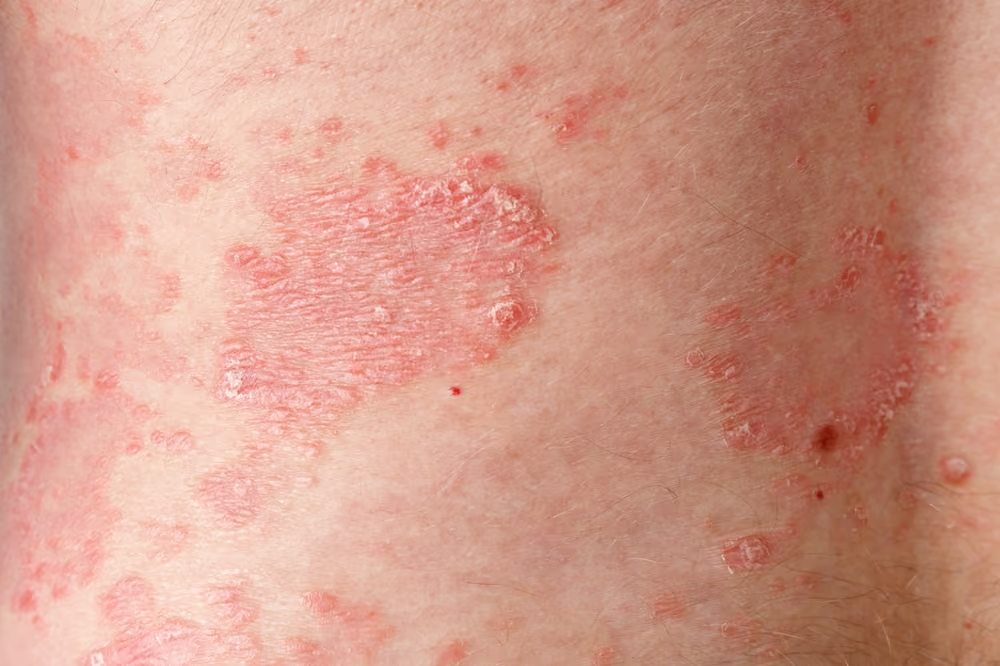
Psoriasis is a chronic inflammatory skin disease characterized by red, thickened patches covered with silvery-white scales. The name is derived from the Greek word psora, which refers to itching. However, not everyone with psoriasis experiences itching. The condition has periods of flare-ups and remission.
With psoriasis, skin cell renewal occurs much faster than normal. Healthy skin renews itself in about a month, whereas with psoriasis, this happens within just a few days. As a result, skin cells accumulate on the skin's surface, leading to the typical scaly plaques. This is because the immune system becomes dysregulated and produces inflammatory substances that stimulate skin cells to divide at an accelerated rate.
Psoriasis is absolutely not contagious. You cannot contract the condition through skin contact with someone who has psoriasis. This is important to emphasize, as people with psoriasis are unfortunately still often confronted with misconceptions about it.
People with psoriasis have an increased risk of other conditions: diabetes, obesity, cardiovascular diseases, and disturbed cholesterol levels. This is because psoriasis is a systemic inflammatory disease that can also affect inflammatory processes elsewhere in the body. Regular monitoring of general health is advisable. Does your skin complaint seem more like another condition? Read more about the distinction with eczema, where the patches are often less clearly defined and itch more intensely.
Do you suffer from Psoriasis?
Personalized advice for your skin, completely online. Upload a few photos through the Skindr app and receive medical advice from a licensed dermatologist within 48 hours. No waiting room or referral required.
How does psoriasis develop?
The exact cause of psoriasis is not yet fully understood, but we know that multiple factors play a role.
Heredity is an important factor. If one of your parents has psoriasis, you have about a ten percent chance of developing it as well. If both parents have psoriasis, this risk increases to approximately fifty percent.
Your immune system plays a central role. In psoriasis, a specific type of white blood cell, the T-cell, is overactive. These cells produce inflammatory substances that stimulate skin cells to divide very rapidly. Therefore, medications that suppress the immune system are effective in treatment.
Triggers that activate or worsen the condition: infections (streptococcal throat infection can trigger guttate psoriasis), stress, certain medications (medications for high blood pressure, lithium, and certain anti-inflammatory drugs can trigger or worsen psoriasis), smoking, excessive alcohol consumption, and the Koebner phenomenon (psoriasis appearing at the site of a scratch or tattoo).
In summer, psoriasis improves for many people due to sunlight, while in winter, it worsens due to dry air. Another chronic skin condition with redness that also occurs in flare-ups is rosacea.
Symptoms and characteristics of psoriasis
Psoriasis manifests in various forms, each with its own characteristic features.
The most common form is plaque psoriasis, accounting for about ninety percent of all cases. The typical psoriatic lesion is a sharply defined, red patch covered with silvery-white scales. When you carefully scratch off a scale, small pinpoint bleeding spots appear: Auspitz's sign, very characteristic of psoriasis.
Guttate psoriasis primarily affects young people and often appears suddenly after an infection: many small red spots spread across the body.
Inverse psoriasis occurs in skin folds such as armpits, groin, and the gluteal cleft. The typical scales are absent here: the skin is red and smooth and shiny.
Pustular psoriasis is a rare form characterized by pustules or blisters. Nail abnormalities occur in about half of all people with psoriasis: small pits, thickening, discoloration, or separation of the nail bed. Read more about these and other nail problems and when an assessment is advisable.
Psoriatic arthritis is a form of joint inflammation that occurs in 10 to 30 percent of people with psoriasis. Early recognition and treatment are important to prevent permanent joint damage.
Are you unsure if your red patches are psoriasis? Through Skindr, a certified dermatologist will assess your skin within 48 hours, without a waiting room.
Where does psoriasis occur?
Psoriasis has clear preferred locations. The most characteristic locations are the extensor surfaces of the elbows and knees: about seventy percent of people with plaque psoriasis have patches in these locations. The lower back and sacrum are also common locations.
The scalp is affected in about fifty percent of people with psoriasis. Scalp psoriasis ranges from mild flaking to thick, raised patches that can extend beyond the hairline. Ears, eyebrows, and the hairline can also be affected. Read more about psoriasis and other scalp conditions and what causes the flaking.
Skin folds such as armpits, groin, and the gluteal cleft can develop inverse psoriasis. Palms and soles can be affected. Nails in about half of patients. The distribution varies greatly from person to person. For comparison: read more about atopic eczema in adults, which often appears in folds and is itchier.
Do you suffer from Psoriasis?
Personalized advice for your skin, completely online. Upload a few photos through the Skindr app and receive medical advice from a licensed dermatologist within 48 hours. No waiting room or referral required.
Psoriasis Treatment
Psoriasis is not curable, but there are effective treatments that can significantly reduce symptoms. If you experience few or no symptoms from your psoriasis, you don't need to treat it.
Topical treatment is the foundation for mild to moderate psoriasis. Products containing salicylic acid or urea help loosen scales. Vitamin D preparations inhibit rapid cell division. Local corticosteroid medications work quickly during flare-ups. Thorough hydration with rich creams also helps against itching and dryness that can occur with psoriasis.
Light therapy or phototherapy exposes the skin to narrow-band UVB light, two to three times a week for several months. According to DermNet , phototherapy is a standard treatment option for more extensive psoriasis.
Lifestyle Advice
Quitting smoking improves psoriasis for many. Moderate alcohol consumption. Healthy eating and maintaining a normal weight help because obesity can worsen psoriasis. Stress reduction through relaxation techniques or exercise. Daily sunlight can be beneficial (avoid sunburn).
Systemic medications and biologics are reserved for severe psoriasis that does not respond to topical treatment and light therapy. The NICE guideline for psoriasis describes when this step is indicated. Biologics are targeted medications that address specific components of the immune system. They are administered via injections and can yield spectacular results for severe psoriasis. Only prescribed by a dermatologist with close monitoring.
Are you unsure about your psoriasis or want to know which treatment is suitable? Through Skindr, a certified dermatologist assesses your skin within 48 hours, without a waiting room.
What doesn't help with psoriasis?
Unfortunately, making psoriasis disappear completely is not possible. It is a chronic condition. Keeping expectations realistic helps prevent disappointment.
The idea that psoriasis is contagious is incorrect. You don't need to isolate yourself.
Miracle cures that promise to permanently cure psoriasis are not trustworthy. There is no miracle cream or miracle pill. Be skeptical of expensive products with grand promises.
Using overly strong corticosteroid medications long-term without medical advice is not wise. Close monitoring by a doctor is important to prevent side effects and ensure the treatment proceeds safely.
Simply stopping your treatment as soon as psoriasis improves can lead to a rapid recurrence. Maintenance treatment is often necessary for chronic conditions.
Ignoring the psychological impact of psoriasis is a missed opportunity. Psoriasis can damage your self-confidence and lead to feelings of depression. Talk about it with your doctor or a psychologist.
Frequently asked questions about psoriasis
Can psoriasis be cured?
No, unfortunately, psoriasis cannot be cured. It is a chronic condition. However, there are effective treatments that can significantly reduce symptoms. With the right approach, long periods with few or no symptoms are possible.
Can I infect myself or others?
No, psoriasis is absolutely not contagious. You cannot transmit it through touch, kissing, or shared towels. Psoriasis is a condition of your own immune system.
Which lifestyle changes help with psoriasis?
Quitting smoking can improve psoriasis for many people. A healthy weight, reduced alcohol intake, stress reduction, and careful sun exposure (avoid sunburn) can also be beneficial. Good hydration with rich creams helps combat dryness and itching.
Can I swim if I have psoriasis?
Yes. Chlorinated water can dry out the skin, so moisturize well after swimming. Salty seawater is often beneficial. Psoriasis is not contagious, so there's no need to feel ashamed.
Can I have children if I have psoriasis?
Yes, psoriasis does not affect fertility. However, discuss your treatment with your dermatologist if you plan to become pregnant, as some medications are not safe during pregnancy.
Can Skindr help with psoriasis?
Yes. Through Skindr, a certified dermatologist assesses your skin based on photos and provides treatment advice, without a waiting room, within 48 hours. For extensive psoriasis or psoriatic arthritis, we refer you to the appropriate specialist.
Resources
Sources: Health and Science: Psoriasis · EBPNet · UZ Leuven: Psoriasis

](https://static.legitscript.com/seals/624359.png)