.webp)


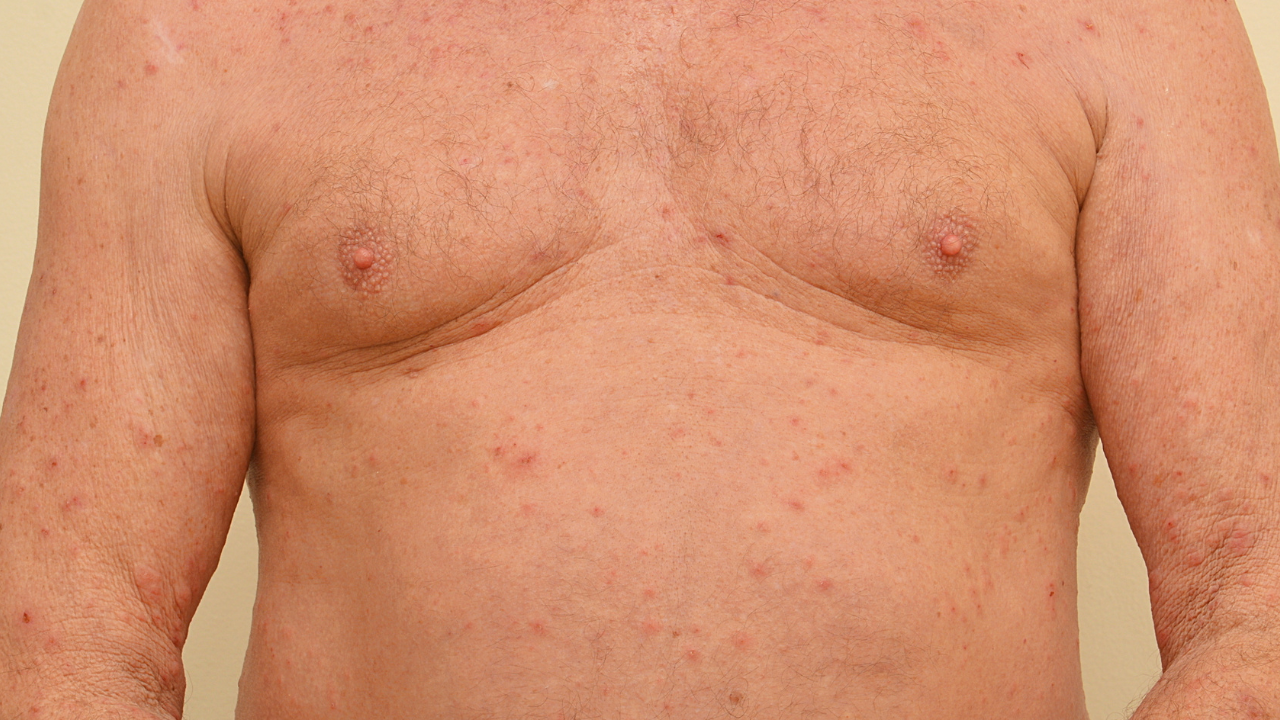
What is scabies?
Scabies is a contagious skin infection caused by a microscopic mite: the scabies mite, scientifically known as Sarcoptes scabiei. The female mite burrows into the outer layer of the skin to lay eggs, which causes an intense allergic reaction and itching. The medical term is scabies.
Scabies has an undeserved negative image. Anyone can get scabies, regardless of hygiene or social circumstances. It is an infection, not a sign of poor hygiene.
In people with severely weakened immune systems, a severe variant can occur: scabies norvegica. In this rare form, the skin is covered with crusts and can contain millions of mites. Crusted scabies is extremely contagious and requires urgent medical treatment.
Scabies is fully treatable, but the treatment must be carried out correctly and completely to prevent re-infection.
Do you suffer from Scabies?
Personalized advice for your skin, completely online. Upload a few photos through the Skindr app and receive medical advice from a licensed dermatologist within 48 hours. No waiting room or referral required.
How is scabies transmitted?
Scabies is transmitted through prolonged, direct skin-to-skin contact, typically lasting at least 15 continuous minutes. Indirect transmission via clothing, towels, or bedding is possible, but less common.
In a first infection, it takes 2 to 6 weeks for itching to begin: the body first needs to build an allergic reaction. In a re-infection, where the immune system already recognizes the mite, symptoms start after just 1 to 4 days.
You are contagious as long as treatment has not started. You are no longer contagious just 12 hours after starting treatment.
The most common mistake is treating only the person with symptoms. All close contacts (household members, sexual partners) must be treated simultaneously, even if they have no symptoms. This prevents the 'ping-pong effect,' where you repeatedly re-infect each other.
Scabies is not a sexually transmitted infection in the strict sense, but it is often transmitted through intimate physical contact.
Symptoms and characteristics of scabies
The most characteristic symptom of scabies is an intense itch that significantly worsens at night and after a warm shower. This itch is an allergic reaction of the body to the mites, eggs, and feces.
Visible on the skin are small, zigzag-shaped grayish lines 5 to 15 millimeters long: these are the burrows of the scabies mite. These are visible to the naked eye but require a trained eye. Additionally, red bumps, blisters, and scratch marks may be present.
Assessment is made through a skin examination, sometimes with a dermatoscope. Self-assessment based on photos is difficult: have a doctor assess the skin.
In young children under 2 years old, the presentation differs from adults: the burrows are more often found on the head, neck, palms of the hands, and soles of the feet. Crusting and blisters are more frequently present in children.
Are you unsure if it's eczema or an itchy rash , or scabies? Send a photo via Skindr: a certified dermatologist will assess it and give you personalised advice within 48 hours.
Where on the body does scabies occur?
In adults, the burrows and bumps are most often found in the finger webs and on the inside of the wrist. The armpits, elbow creases, abdomen, buttocks, genitals, and soles of the feet are also frequently affected.
Scabies typically does not affect the face and scalp in adults, but it can in young children and babies. In children younger than 2 years old, the burrows are more often found on the head, neck, palms of the hands, and soles of the feet.
Do you suffer from Scabies?
Personalized advice for your skin, completely online. Upload a few photos through the Skindr app and receive medical advice from a licensed dermatologist within 48 hours. No waiting room or referral required.
Scabies Treatment
Scabies does not go away on its own. Treatment consists of three steps: the treatment itself, hygiene measures, and informing all close contacts.
Treatment
The first choice is a cream for certain parasitic skin conditions (5%): it is applied to the entire body from neck to feet and should be left on for 8 to 12 hours. A second treatment follows after 7 days. An alternative is a tablet treatment for certain parasitic skin conditions, taken in two doses a week apart.
Hygienic measures
Along with the treatment, bedding, clothing, and towels must be washed at 60 degrees Celsius, or stored in a sealed plastic bag at room temperature for 3 days. Vacuuming mattresses and sofas is helpful. Doors and surfaces do not need to be disinfected: the scabies mite only survives outside the skin for 24 to 72 hours.
Who else needs treatment?
All household members and close contacts must be treated simultaneously, even if they have no symptoms. This is the only way to prevent the ping-pong effect.
Itching after treatment: what's normal?
Post-scabies itching can persist for 2 to 6 weeks after successful treatment. This is not a sign that the treatment has failed. Through Skindr, you can submit a photo and ask for advice from a certified dermatologist.
What doesn't work against scabies?
Treating only yourself while household members and close contacts remain untreated is the most common mistake: the ping-pong effect leads to immediate re-infection. Washing off the cream too early (before the 8 to 12-hour application time) makes the treatment incomplete. Washing clothes and bedding at 40 degrees Celsius is insufficient: scabies mites survive washes below 60 degrees Celsius. And waiting for the itching to go away on its own also doesn't work: scabies does not disappear spontaneously, and you remain contagious as long as you haven't been treated.
Frequently asked questions about scabies
How do I know if I have scabies?
The typical combination of intense nocturnal itching and small burrows or bumps in the finger webs or on the wrists strongly suggests scabies. Confirmation by a doctor through skin examination or microscopy is always recommended.
How long are you contagious with scabies?
You are contagious as long as treatment has not started. As early as 12 hours after the first treatment, you are no longer contagious to others.
Can you go to school or work with scabies?
After treatment has started, you can return to school or work the next day. Inform the school or employer so that potentially infected contacts can also be treated.
What if the itching returns after treatment?
Post-scabies itching can persist for 2 to 6 weeks after treatment. If the itching is still present after 6 weeks or new burrows appear, consult a doctor again: there may be a re-infection.
Does health insurance cover scabies treatment?
In Belgium, this cream and the tablet treatment are reimbursed via your GP or dermatologist. Consult your doctor for the specific reimbursement conditions.


](https://static.legitscript.com/seals/624359.png)