.webp)




February 4 is World Cancer Day, a topic that is of course close to our hearts as doctors. That is why today we would like to focus on skin cancer and even more on its prevention and early detection.
What exactly is skin cancer, what types are there and what can you do to prevent or heal very quickly? We are happy to help you spot suspicious spots in time, so you don't have to worry, so that the cancer has no chance to grow further, so you can take immediate action.
What are the most common forms of skin cancer?
melanoma
Melanoma is a malignant tumor in the skin. This type of cancer occurs because melanocytes, the cells in your body that produce pigment, begin to grow abnormally and thus “take over” surrounding tissue. This can happen from pre-existing birthmarks, but a new mole can also develop.
Usually, one of your birthmarks suddenly changes or a new spot appears that grows rapidly. It will stand out because of its rapid growth, its erratic shape or multiple colors. Sometimes the stain can also bleed.
Melanomas are a more aggressive form of skin cancer: that is, they can metastasize. Most often, this occurs initially to the nearest lymph nodes. Early recognition is crucial to avoid this.
Dermatologists will therefore completely remove the suspicious spot if melanoma is suspected. Afterwards, a tissue study will be carried out, which will assess the risk of metastasis. If there is a high risk of metastasis, further examinations will be agreed. If it is a low-risk melanoma, removing the healthy skin around the melanoma scar more widely, a “safe margin”, is sufficient.
Immunotherapy may be a possible treatment for high-risk melanomas with metastases.
Basal cell carcinoma (BCC)
Basal cell carcinoma is the most common but also the “least malignant” form of skin cancer. This cancer starts in the top layer of the skin, or the epidermis, and grows very slowly. Metastases in the body are extremely rare.
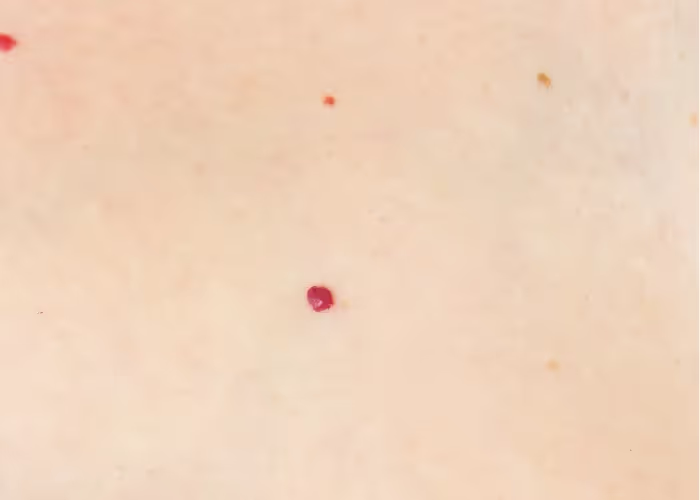
Basal cell carcinomas are very often linked to prolonged exposure to the sun, especially to UVA rays. That is why the spots occur in places that have had a lot of sun for years. They don't look as suspicious at first, as light red spots or nodules.
The treatment of basal cell carcinoma is relatively easy. If you are unsure about the diagnosis, you will dermatologist first cut off a small piece of the stain for further examination, also known as a biopsy. If it is a basal cell carcinoma, it will be completely removed afterwards. Note: the larger the spot, the harder to treat, the bigger the scar. So don't wait too long to have suspicious spots checked.
Squamous Cell Carcinoma (PCC)
Squamous cell carcinoma is the second most common form of skin cancer and develops when the damage of UV rays causes abnormal changes in the top layer of skin. It looks like a pink lump on the skin, a sore wart, or in some cases a wound.
If squamous cell carcinoma is suspected, the dermatologist take a biopsy (piece of tissue from the stain) for further examination. If it indeed turns out to be squamous cell carcinoma - and therefore cancer -, you will dermatologist cut it completely away. In most cases, that is sufficient.
Squamous cell carcinomas can metastasize, but this is not common: 4 out of 100 people will experience metastases. Tissue research therefore also looks at the risk of metastasis. This depends on the growth pattern and the location of the squamous cell carcinoma. Depending on this, further research into metastases will be agreed.
Because this form of skin cancer is triggered by prolonged sun exposure (and the sun has therefore often damaged the skin more widely), good follow-up control is necessary for the development of new abnormalities due to the dermatologist needed.
The crucial control of your birthmarks
Why is it important to check your birthmarks?
Prevention and early detection are crucial in skin cancer. Of course, you'd rather prevent skin cancer than have to cure it. And fortunately, you can play a major role in that yourself. As explained above, skin cancer is often caused by exposure to UV rays. Should you avoid the sun completely now? No, but enjoy the sun in moderation and protect yourself well with a high SPF are recommended.
Be there at an early stage this means that the malignant spots can be removed more easily, that scar tissue remains small, but especially that melanomas or squamous cell carcinomas do not have the chance to spread.
What is the best way to control your birthmarks?
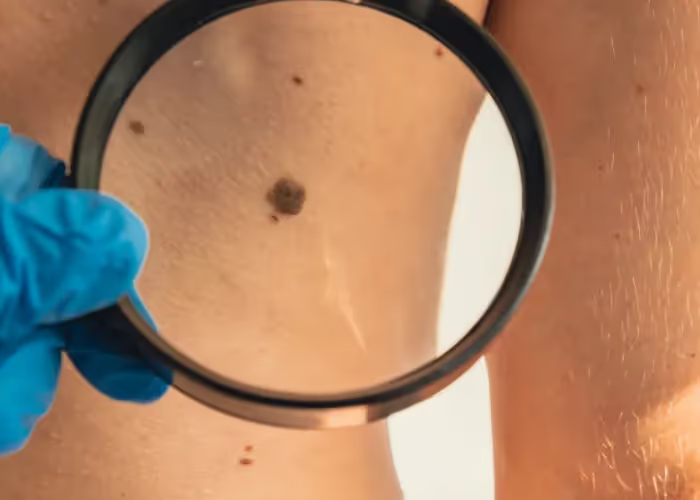
self know your skin well is a first step to promote early detection of skin cancer. Do you know what (mother) spots you currently have? Start with that question and map out what they look like now. That way, you will notice more quickly when a new spot appears, or if an existing spot starts to behave restlessly and suspiciously.
Would you like to check for yourself whether you might have a melanoma? Then you can do that via the ABCDE method. In addition, you will pay attention to 5 things when checking the mole that you suspect could be a “bad one”.
- Asymmetry (asymmetry): is the mole nicely round or does the shape differ?
- Border (edge): does the mole have an irregular, unclean edge?
- CColor: (color): is the mole even or do you notice multiple colors?
- DDiameter: is the mole larger than 5mm and is it growing fast?
- Evolution (evolution): does the mole appear or change suddenly - growth, color change, itching?
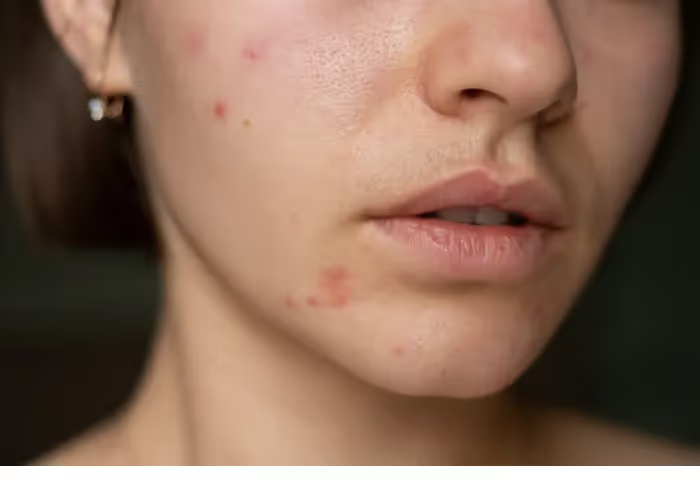
Do you have the slightest doubt about a spot? Contact then as soon as possible your doctor or dermatologist. This is a second important step. They can proceed to a biopsy and act quickly if necessary. Want to get medical advice within 48 hours? Upload a photo and description of the suspicious spot via skindr.com and we will ensure that you receive advice from an experienced person within two days dermatologist.
Tips for creating a routine for checking moles
- Set for yourself a monthly reminder for example, on your mobile phone that reminds you to check your birthmarks. Preferably on the same day every time, because that's how you really make a habit out of it.
- Hang one post-it on your bathroom mirror that helps you remember to check regularly.
- Every time you shower, check to make sure you see nothing suspicious on your skin. Look for red nodules or crazy spots in shape, color, or size.
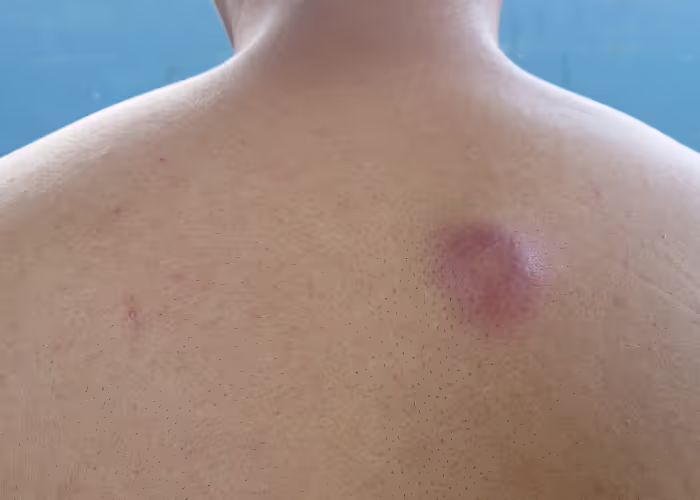
- Ask someone close to you for spots in hard-to-see areas (for example on your back) to check from time to time.
- Take a photo every so often from a spot that makes you feel bad. This way, you can follow the evolution.




%20(1).avif)
.avif)


%20(1).avif)
.avif)
.avif)

.avif)


-min.avif)
-min.avif)
-min.avif)

.avif)


.webp)

























.avif)


](https://static.legitscript.com/seals/624359.png)